Best Slow Feeder Dog Bowls (2026): For Dogs That Inhale Dinner
Eating fast is one of the few bloat risk factors you can actually change, and a $15 bowl is the cheapest way to change it. Here are the four slow-feeder formats, which dog each one suits, and the mistake that undoes the whole thing.
Some links below are affiliate links. If you buy through them, WoofTested may earn a small commission at no extra cost to you, including as an Amazon Associate, where we earn from qualifying purchases. We only recommend products that pass our Fit Analysis — and we publish the ones that don't.
For most dogs, a molded maze bowl is the right first buy. It works with dry kibble, needs no training, costs about as much as a bag of treats, and it is the format almost every fast eater tolerates. Slow feeder bowls on Amazon is where the category lives.
The other three formats solve different problems: a snuffle mat for the dog who needs the meal to be calming, a lick mat for wet food and for holding a nervous dog still, and a puzzle feeder for the dog whose real problem is boredom rather than speed.
One thing matters more than which bowl you buy: do not put it on a raised stand. The same body of research that flagged fast eating as a risk factor for bloat flagged raised feeding bowls as a bigger one. Buying a slow feeder and elevating it is taking one step forward and two back.

What the research actually supports
This category gets sold on bloat prevention, so it is worth being precise about what is and isn't established.
Gastric dilatation-volvulus (GDV, commonly called bloat) is the emergency where a dog's stomach distends and twists. It is fast, it is fatal without surgery, and it hits large and giant deep-chested breeds hardest. The most-cited work on its risk factors is a Purdue prospective study of more than 1,600 dogs across eleven high-risk breeds, published in JAVMA in 2000. Four things came out significantly associated with higher GDV risk: increasing age, having a first-degree relative with a GDV history, a faster speed of eating, and feeding from a raised bowl.
That is the honest basis for this whole product category. Eating speed is one of the few items on that list you can do anything about, and a slow feeder is the cheapest intervention that targets it.
What has *not* been shown is that a slow feeder bowl itself prevents GDV. No study has run that trial. The chain of reasoning is: fast eating is associated with GDV, slow feeders reliably slow eating, therefore they plausibly help. That is a reasonable bet at fifteen dollars, and it is not a guarantee. Treat any listing that promises bloat prevention as marketing.
The better-documented wins are the everyday ones: less gulped air, fewer of those meals that come straight back up five minutes later, and a dog who is meaningfully more settled after dinner.
The raised-bowl trap. In that same Purdue data, raised feeders were associated with a substantially increased share of GDV cases, with the effect largest in giant breeds. If you have been told to elevate your big dog's bowl to prevent bloat, that advice predates the research and points the wrong way. Keep the slow feeder on the floor.
The four formats, compared
| Format | Best for | Food type | Training needed | The catch |
|---|---|---|---|---|
| Maze bowl | The default fast eater | Dry kibble | None | Deep channels defeat flat-faced dogs; cheap plastic can chip |
| Snuffle mat | Anxious or over-aroused dogs | Dry kibble | A meal or two | Machine-washable is non-negotiable; some dogs just shake it out |
| Lick mat | Wet food, toppers, holding a nervous dog still | Wet, raw, yogurt, spreads | None | Not a full meal for most dogs — it's a supplement or a calming tool |
| Puzzle feeder | Bored dogs, rainy days, crate prep | Dry kibble, treats | Yes, in stages | Slower to load and clean; some dogs solve it in a week |
How to pick the format for your dog
Your dog eats kibble in eleven seconds and is otherwise fine. Buy a maze bowl and stop researching. The molded ridges force the dog to work around obstacles instead of scooping, and the effect is immediate — no learning curve, no setup, nothing to teach. This is the 80% answer and it is the cheapest one.
Your dog eats fast because they're wound up. A snuffle mat turns the meal into a foraging job. Kibble goes down into the fabric strips and the dog has to sniff it out, which is calming in a way that fighting a plastic maze is not. Sniffing is genuinely settling work for dogs, so this is the pick when speed is a symptom of arousal rather than appetite. Buy machine-washable, because you will need to.
Your dog is on wet or fresh food. Maze bowls are built around kibble; wet food smears into the channels and turns cleaning into a chore. A lick mat is the format that fits — spread a portion across the texture and the dog works at it for several minutes. It doubles as the best tool in the house for nail trims, baths and vet-visit prep, because a licking dog is a dog holding still. For most dogs it supplements the bowl rather than replacing it.
Your dog isn't hungry, they're bored. A puzzle feeder makes them earn the meal by nudging, rolling or sliding pieces. This is the format with a real training curve — start on the easiest setting, let them win early, and step up difficulty only once they're confident. Done wrong it produces a frustrated dog who quits; done right it replaces a walk on a day when a walk isn't happening.
A hybrid is often the honest answer: most of the meal in the maze bowl, a spoonful spread on a lick mat beside it.
Two failure modes worth knowing before you buy
Flat-faced dogs and deep mazes don't mix. Pugs, French bulldogs, boxers, shih tzus and other brachycephalic breeds physically cannot get into narrow, deep channels. They strain, they give up, or they push the bowl around the kitchen. These are also dogs whose breathing you don't want to make harder at mealtime. Look for shallow, wide grooves — there are slow feeders made specifically for short-snouted dogs — or skip the maze entirely and use a snuffle mat or lick mat, both of which present food on a flat surface.
The bowl that ends up upside down. A dog who can't solve the bowl fast enough will often flip it, and a light plastic bowl slides across a tile floor while they try. Fixes, in order of how well they work: buy a bowl with a real rubber base ring rather than a molded lip, put the bowl on a rubber mat, or step down to an easier maze pattern. If your dog is flipping the bowl every meal, the pattern is too hard for them and you are training frustration, not patience.
What to buy
Category links to Amazon, so you can compare current models and sizes rather than chase a single listing. Prices and stock change constantly.
Start hereMolded maze bowl
The default for a kibble-fed fast eater. Buy the size matched to your dog and check that the base has a real rubber ring, not just a molded lip.
Check price on Amazon Best material
Stainless bowl with a slow-feed insert
The upgrade if you would rather not feed out of plastic. The insert lifts out, so the bowl underneath cleans like a normal bowl.
Check price on Amazon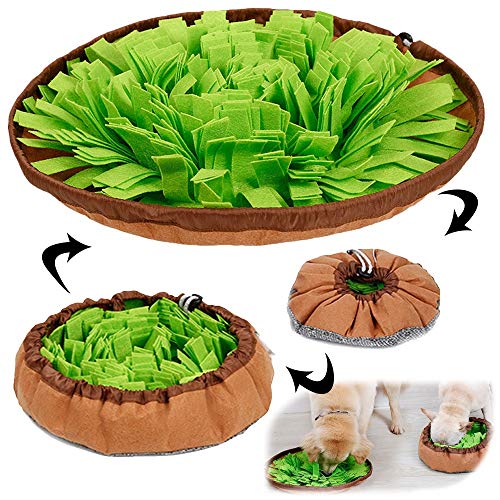 Calmest option
Snuffle mat
Turns dinner into a foraging job. The pick for dogs whose eating speed is really about arousal. Buy machine-washable.
Check price on Amazon For wet food
Lick mat
The format for wet, fresh or raw portions, and the best tool in the house for holding a nervous dog still during grooming.
Check price on Amazon For bored dogs
Puzzle feeder
Makes the dog solve for the meal. Start on the easiest level and step up only once they are winning consistently.
Check price on AmazonWhat to look for on the listing
A base that actually grips. This is the single most common complaint in the category and the easiest thing to check. A rubber ring around the bottom beats a molded plastic lip every time.
Material, honestly assessed. Most maze bowls are hard plastic, and for most dogs that is fine. It stops being fine if your dog chews the bowl — chipped plastic ridges are a swallowing hazard, and a dog who treats the bowl as a chew toy should be on a stainless bowl with a lift-out insert instead. Check the bowl monthly for cracks and gouges and retire it when it has them.
Dishwasher-safe, top rack. Maze channels are miserable to hand-wash, and this is the feature that decides whether you keep using the thing after week three. Confirm it on the listing rather than assuming.
Capacity in cups, not size labels. "Large" means different things to different brands. Check that the stated capacity holds your dog's actual portion, which you can work out with our portion math guide. A bowl that only holds two-thirds of dinner means two rounds of loading, every meal, forever.
Slow feeder bowls: FAQ
Do slow feeder bowls actually prevent bloat?
No one has demonstrated that. What is established is that fast eating is significantly associated with GDV risk in large and giant breeds, and slow feeders reliably slow eating. That makes them a sensible, cheap intervention against a documented risk factor — not a guarantee against an emergency. Any listing that flatly promises bloat prevention is overselling.
Should I raise my big dog’s bowl to prevent bloat?
No. That advice was common for years, and the Purdue GDV research pointed the opposite way: raised feeding bowls were associated with increased GDV risk, with the largest effect in giant breeds. Feed at floor level unless your vet has told you otherwise for a specific medical reason.
How much do slow feeder bowls actually slow a dog down?
Manufacturers quote figures like ten times longer, which are marketing numbers rather than independent measurements. What owners consistently report is the difference between a meal that vanishes in seconds and one that takes several minutes. If you want your own number, time one meal before and one after — it takes two minutes and beats anyone’s claim.
Are slow feeders safe for flat-faced dogs like pugs and bulldogs?
Standard deep-maze bowls usually are not. Short muzzles cannot reach into narrow channels, so the dog strains or gives up. Use a bowl with shallow, wide grooves designed for short snouts, or switch to a snuffle mat or lick mat that presents food on a flat surface.
My dog just flips the bowl over. What now?
That is a difficulty problem, not a stubbornness problem. Move to a simpler maze pattern, buy a bowl with a rubber base ring, or set the bowl on a rubber mat. If it keeps happening, the format is wrong for that dog and a snuffle mat is usually the fix.
Can I use a slow feeder with wet or fresh food?
Maze bowls are designed around kibble and wet food packs into the channels, which makes cleaning unpleasant. A lick mat is the format built for wet, fresh and raw portions. If you are feeding a fresh diet and want the enrichment anyway, spread part of the portion on a lick mat and serve the rest in a normal bowl.
Will a slow feeder help my dog lose weight?
Only indirectly. A slow feeder changes the pace of a meal, not its calorie count, though a slower meal does give the dog time to register fullness and may cut the begging that follows. Weight comes off through portions, which is a measuring problem rather than a bowl problem.
Related reading
A slow feeder changes how the food goes down, not how much of it there is. For that half of the problem, start with how much should I feed my dog, which covers the portion math most owners get wrong. If you are switching foods at the same time, do it on the schedule in how to transition your dog to new food rather than all at once. Feeding fresh or considering it? See is fresh dog food worth it and our fresh delivery comparison. And how we test explains what our Fit Analysis scoring does and does not claim.