Best Vacuum for Dog Hair on Hardwood Floors (2026)
On a hard floor, suction is not what fails you. An aggressive carpet brush roll pushes light dog hair into a wave ahead of itself, and that single fact reorders the entire category, because almost every "best pet vacuum" list is ranked for carpet.
Some links below are affiliate links. If you buy through them, WoofTested may earn a small commission at no extra cost to you, including as an Amazon Associate, where we earn from qualifying purchases. We only recommend products that pass our Fit Analysis — and we publish the ones that don't.
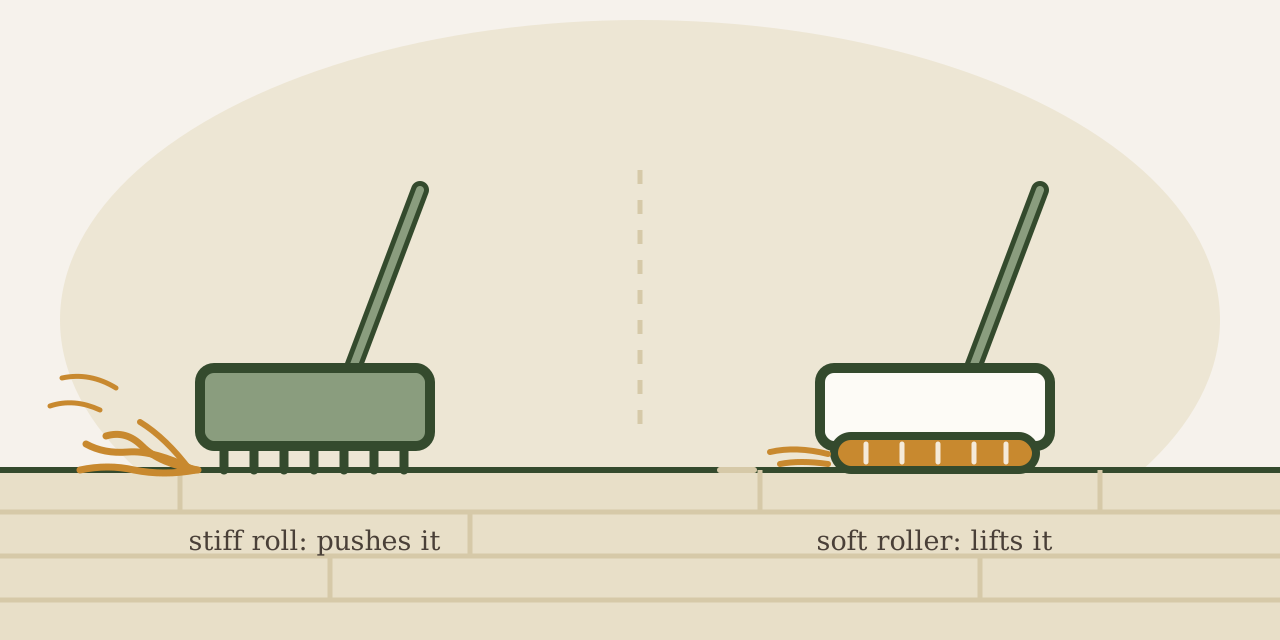
The spec that decides this is what the brush roll does on a hard floor, not how many pascals the box claims. Dog hair on hardwood is light and loose. A stiff, always-on brush roll designed to dig into carpet pile hits that hair and pushes it into a bow wave ahead of the machine, and the fine dander that travels with it gets flung sideways. Two designs solve it, and both are on the box if you know the words:
- A soft roller head (Dyson calls it Fluffy, Tineco calls it a soft-roller power brush): a wide fabric drum that touches the floor gently and rolls hair backwards into the airflow instead of flicking it forwards
- A brush roll you can switch off (Shark labels this brushroll shutoff): the cheap version of the same idea, letting the machine work on raw airflow across a hard floor
The picks, by how you actually clean:
- One machine for the whole house, and you want it to be the good one: a Dyson V15 Detect, because the Fluffy Optic soft roller is exactly the mechanism this page argues for and it ships with a detangling head for the rugs. Flagship money
- Best value on the mechanism: a Shark Navigator Lift-Away NV356E, a corded upright with brushroll shutoff and a sealed HEPA system, at roughly a third of flagship price
- If anyone in the house reacts to dander: a bagged machine like the Miele Classic C1 Cat & Dog. Emptying a bagless bin puts a cloud of what you just collected back into the room
- For the days between real cleans: an anti-tangle robot such as the Roborock Q7 M5+, rubber-style rollers rather than bristles
The tier to skip: "pet edition" bundles that differ from the base model only by an included tool. Check whether the price gap is larger than buying that tool on its own, because it often is.
We have not tested any of these. WoofTested does not have a vacuum bench. Everything below is specification comparison against manufacturer listings and a synthesis of what owners consistently report, and we say which is which.

Why suction is the wrong spec on a hard floor
Carpet and hardwood are opposite problems, and the vacuum industry is built around the first one.
On carpet, hair is trapped. It works down between fibres and stays there, so the job is agitation: a stiff brush roll beating the pile to release hair, and enough suction to pull it up through the carpet. Every spec that gets advertised, pascals, air watts, motor size, is a carpet spec.
On hardwood, hair is already loose, and the machine's own agitation becomes the enemy. There is nothing to dig out. A stiff bristle roll spinning at speed against a hard surface acts like a broom held at the wrong angle: it catches light hair and throws it forward, so a drift builds up just ahead of the head and travels with you across the room. You make a pass, and the hair is now in front of the machine rather than in it. Owners describe this as the vacuum "pushing hair around" and usually blame suction, which is why they buy a more powerful machine and get the same result.
The fix is contact, not force. A soft roller is a wide fabric or microfibre drum that meets the floor along its whole length and seals against it, so hair goes under and back into the airflow rather than being flicked out. Switching a brush roll off achieves a rougher version of the same thing: with no agitation, the head becomes a plain suction nozzle, which is all a hard floor ever needed.
Dander is the second half of the problem, and it is quieter. Hair is what you see; the fine skin particles that shed alongside it are what settles on everything and what people react to. Those are small and light enough that an unsealed vacuum will pass them through the motor and out the exhaust, or leak them around a badly seated filter. This is what manufacturers mean by a sealed system, and it is worth more on a hard floor than on carpet, because there is no pile holding the fines down between cleans.
So the ranking on this page is not the ranking you will see on a general "best pet vacuum" list. It is: what does the head do on a hard floor, is the exhaust sealed, and will long hair wrap the roll.
The shortlist, compared on what matters here
| Machine | Type | On a hard floor | Bin or bag | Listed weight | Tier |
|---|---|---|---|---|---|
| Dyson V15 Detect | Cordless stick | Soft roller head (Fluffy Optic), plus a detangling head for rugs | Bagless bin | 6.8 lb | Flagship |
| Shark Navigator Lift-Away NV356E | Corded upright | Brushroll shutoff, sealed HEPA system | Bagless bin, 0.87 L | 13.7 lb | Budget |
| Miele Classic C1 Cat & Dog | Corded canister | Separate Parquet floorhead, no roll on hard floors | Bagged, 4.8 qt | 16.1 lb | Premium |
| Tineco Pure ONE S15 Pet | Cordless stick | Anti-tangle brush; soft-roller head sold for the range | Bagless bin | 6.8 lb | Mid |
| Shark Pet Plus cordless (UZ365H) | Cordless stick | Self-cleaning brushroll, no dedicated soft roller | Bagless bin | Not listed | Mid |
| Roborock Q7 M5+ | Robot, self-emptying | Dual anti-tangle system, rubber-style roller | Bin + self-empty dock | 10.58 lb | Mid |
| Bissell Pet Hair Eraser 33A1 | Corded handheld | Furniture, stairs and the car, not floors | Bagless bin | Not listed | Budget |
The picks
Chosen on published specifications and stated features against the mechanism above, plus a synthesis of what owners consistently report. WoofTested has not tested any vacuum, and any percentage or capacity below is a manufacturer claim we are citing, not a measurement we made. Weights and dimensions come from Amazon product data. We do not quote prices: everything in this category discounts heavily and constantly, so check the current price at each link.
WoofTested PickDyson V15 Detect
The reason it wins this specific question is the Fluffy Optic soft roller, which is the exact head design a hard floor needs, and it ships alongside a Digital Motorbar that Dyson designs to detangle hair for when you cross onto a rug. Whole-machine filtration is claimed to capture 99.99% of particles down to 0.3 microns. Listed at 6.8 lb, 49.6 in assembled height, model 447261-01. It converts to a handheld, which quietly removes the need for a separate one.
Check price on Amazon Best value on the mechanism
Shark Navigator Lift-Away NV356E
Brushroll shutoff is printed on the listing, which is all this page is really asking for, and the pod lifts off the body so you can carry it to stairs and furniture. Anti-allergen complete seal with a HEPA filter, 0.87 L dust cup, listed at 13.7 lb. It is corded and it is heavier than a stick, and it costs a fraction of the flagship. If budget is the constraint, buy this and put the difference into the deshedding half of the problem.
Check price on Amazon If dander is the real complaint
Miele Classic C1 Cat & Dog
The bagged answer, and the reason to consider one is emptying rather than collecting: tipping out a bagless bin full of dog hair aerosolises the fine material you just picked up, and a sealed bag goes in the bin intact. Ships with an Electro Plus floorhead plus a separate Parquet floorhead for hard floors, a mini turbo brush for upholstery, and a 4.8 qt bag. Miele claims AirClean filtration of more than 99.9% of fine dust. Listed at 16.1 lb, model 10639470. Ongoing bag cost is the honest trade.
Check price on Amazon The value cordless
Tineco Pure ONE S15 Pet
Same 6.8 lb listed weight as the Dyson and the same basic proposition at a lower tier: an anti-tangle brush, LED headlights that genuinely help on a dark hard floor because they sidelight hair you cannot otherwise see, and 45 in of assembled height. Tineco sells a full-size soft roller head across the Pure ONE range, so check whether your chosen bundle includes one before assuming it does.
Check price on Amazon For the days in between
Roborock Q7 M5+
A robot does not replace the real clean; it stops hair reaching the density where the real clean is a job. Buy on the tangle spec and nothing else: this one lists a dual anti-tangle system and a self-emptying dock rated at 7 to 9 weeks, which matters more with a shedding dog than with any other kind of household. 10000 Pa claimed, listed at 10.58 lb. The Q10 S5+ is the all-rubber-main-brush sibling if you have a long-coated dog.
Check price on Amazon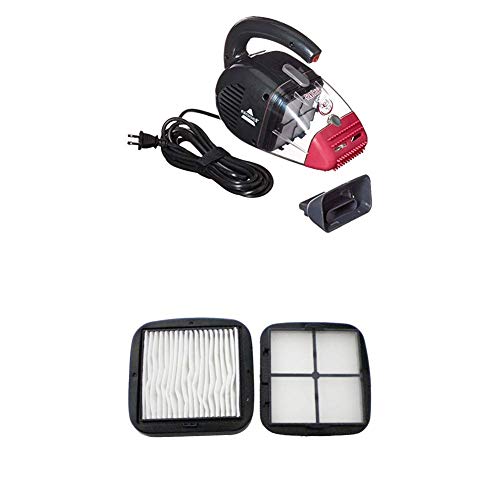 The cheap thing that gets used most
Bissell Pet Hair Eraser 33A1, corded handheld
Corded, so no battery to be flat at the wrong moment, and it lives near the sofa rather than in a cupboard. This is for armrests, stair edges, the dog bed and the car footwell, which is where the hair you actually notice lives. It is not a floor solution and should not be bought as one. If your main machine already converts to a handheld, skip this.
Check price on AmazonWhich format you actually need
The format decision comes before the model decision, and it is mostly about how often you clean rather than how big the house is.
Corded upright or canister, if the clean is a weekly event. You get consistent power with no runtime limit and, usually, better filtration for the money. The cost is friction: it lives in a cupboard, it has to be dragged out, and with a shedding dog on hard floors the interval that actually keeps a floor clear is shorter than most people will sustain with a machine that takes two minutes to deploy.
Cordless stick, if the clean is a daily two minutes. This is the honest recommendation for most hard-floor households with a dog, not because it cleans better but because it gets used. Hair on hardwood accumulates visibly and quickly, and a machine on a wall dock next to the kitchen gets picked up when you notice a drift. The trade is runtime and bin size, both small, and both irrelevant if you are doing one room at a time.
Robot, only as a supplement. It handles the accumulation between real cleans, which on a hard floor is most of the visible problem. It will not do edges properly, it will not do stairs, and with a long-coated dog its lifespan is decided entirely by the roller design. Treat the self-emptying dock as close to mandatory here rather than an upsell: a robot bin fills with dog hair in a day or two.
Handheld, as an addition and never as the plan. Upholstery, stairs and the car are a separate job from floors, and a small corded handheld left where the problem is beats a better machine stored elsewhere.
If you are choosing one and only one, and the floors are hard throughout, a cordless stick with a soft roller is the setup that matches the actual shape of the problem.
The tangle problem, which is what actually kills these machines
Long dog hair wrapping the brush roll is the most consistent long-term complaint in this category, and it is the single biggest difference between a machine that is still good in year three and one that is quietly working at half capacity.
What happens mechanically. Hair catches at the ends of the roll, near the bearings, and winds. As the wrap thickens, the roll sits fractionally further off the floor and the head loses its seal, so suction at the floor drops even though the motor is unchanged. On a robot the same wrap eventually stalls the roll entirely, and most robots will keep driving around with a stalled roller for days before anything tells you.
What actually mitigates it, in rough order of effectiveness:
- A soft roller. Hair has much less to catch on than a bristle strip, and what does collect sits on the surface where you can pull it off
- Rubber or silicone rollers rather than bristles, which is why the anti-tangle robots are all moving to them. This is the spec to buy a robot on
- Anti-tangle combs or a tapered roll, where a fixed comb sits against the roll and feeds wrapped hair into the airflow, or the roll is cut so hair migrates off the end. Shark markets this as a self-cleaning brushroll; Dyson uses a conical roll on its detangling heads
- A roll you can remove without a coin or a screwdriver. Not a mitigation so much as an admission, but a roll that takes thirty seconds to clear gets cleared
None of these are absolute. With a long-coated, heavy-shedding dog you will still be cutting hair off something occasionally. The difference is whether that is a monthly two-minute job or a quarterly surgery with scissors, and whether the machine is losing performance in between without telling you.
Bagged or bagless, when the dog sheds constantly
Bagless won the market on running cost and it deserves to have. There is one specific case where bagged is mechanically better, and a shedding dog is that case.
The problem is emptying, not collecting. A bin full of compacted dog hair and dander does not tip out cleanly. It clings, you shake it, and a visible cloud of fine material comes back up at the exact moment your face is over the bin. Whatever the vacuum captured is then partly back in the room. A bag is sealed at the point of removal and goes straight in the household bin.
Stated plainly and mechanically: this is about where the particles end up, not about anyone's health. If someone in the house reacts to dog dander, that is a conversation with a doctor, and we are not going to tell you a vacuum fixes it. What we can say is that the bagged design has a smaller release point on emptying, and that a sealed system with a HEPA-grade filter is designed so exhaust air leaves through the filter rather than around it.
The trade is real. Bags cost money forever, they are a consumable you can run out of, and the good ones are brand-specific. A large canister bag also lasts a long time with hair, which is bulky but light. Weigh the ongoing cost honestly rather than treating bagged as automatically premium.
If nobody in the house reacts to anything, buy bagless and empty it outside. That is most of the benefit for none of the running cost.
What we did not test. WoofTested has not run a vacuum bench, has not measured pickup on any surface, and has not lived with any of these machines. Every specification above, weights, dimensions, capacities and model numbers, comes from Amazon product data, and every performance figure, including filtration percentages and suction claims, is a manufacturer claim that we are quoting and not confirming. Where we say owners consistently report something, that is a synthesis of published reviews and forum discussion, not our own finding. The mechanism arguments, the bow wave and the tangle failure, are physical reasoning about how these designs work, and you should hold them to that standard.
Vacuuming dog hair on hardwood: FAQ
Do I need a vacuum with high suction for dog hair on hardwood floors?
Less than the marketing suggests. On a hard floor there is no pile holding hair down, so the limiting factor is whether the cleaner head can pick hair up without pushing it forward first. A soft roller head or a brush roll you can switch off matters more than the pascal figure on the box. Suction becomes the dominant spec again the moment you cross onto a rug or a carpeted stair.
How often should I vacuum with a dog that sheds on hard floors?
More often and more briefly than most guides suggest, because hair on hardwood is visible immediately and gathers in drifts along skirting boards and under furniture rather than disappearing into a pile. The practical pattern most owners settle into is a fast daily pass through the main rooms with something that is easy to grab, and a proper full clean weekly. This is the main argument for a cordless stick on a dock over a better machine in a cupboard, and it is also why a robot earns its place: it handles the daily accumulation without you deciding to.
Is a bagged vacuum better than bagless for dog dander?
For emptying, yes, mechanically. Tipping a bagless bin full of hair and fine dander releases some of it back into the room; a bag is sealed before it is removed. That is a statement about where particles go, not a health claim of any kind. If dander is causing a reaction in your household, that is a question for a doctor rather than a vacuum review. For collection and filtration during use, a well-sealed bagless machine with a HEPA-grade filter and a properly seated seal performs comparably.
What does a HEPA filter actually do in a vacuum?
It is a mechanical filter rated to capture a very high proportion of particles at a defined size, commonly quoted at 0.3 microns. The important qualifier is that the filter only does its job if the rest of the machine is sealed: air that leaks around a filter or through a poorly fitted joint has not been filtered at all, which is why manufacturers advertise a "sealed system" separately from the filter itself. A HEPA filter in an unsealed body is a specification rather than an outcome. We make no claim about health effects.
Will a robot vacuum handle a heavy-shedding dog on hardwood?
For daily accumulation on open floor, yes, and that is genuinely most of the visible problem. It will not do edges and corners properly, it will not do stairs, and its useful life with a long-coated dog is decided almost entirely by roller design, so buy on the anti-tangle spec rather than on suction. Treat a self-emptying dock as necessary rather than an upgrade: a robot bin fills with dog hair within a day or two of normal shedding.
Are "pet edition" vacuums worth the extra money?
Sometimes, and it is easy to check. Compare the pet model against the base model of the same machine and identify what is actually different. If the only difference is an included motorised pet tool, price that tool separately and compare. If the difference is the cleaner head design, the filtration seal or the roller material, that is a real difference and worth paying for. The word "pet" on the box is not itself a specification.
Related reading
A vacuum is the expensive end of a problem that starts on the dog. If the shedding itself is the thing that changed, why is my dog shedding so much separates normal seasonal coat blow from the patterns worth a vet visit. If it is normal and you just want less of it on the floor, how to reduce dog shedding covers what actually moves the number, and the deshedding brush shortlist is the fifteen-dollar end of the same job, which removes hair before it lands rather than after. Bathing frequency interacts with all of it, and how often you should bathe your dog is organised by coat type because the answer is not the same for a double coat and a single one.