Is Dog Teeth Cleaning Worth It? The Cost Math (2026)
A professional cleaning under anesthesia is one of the biggest routine bills in dog ownership. Here is what the money actually buys, what daily at-home care can and cannot replace, and how to tell a validated dental product from a marketing claim.
Some links below are affiliate links. If you buy through them, WoofTested may earn a small commission at no extra cost to you, including as an Amazon Associate, where we earn from qualifying purchases. We only recommend products that pass our Fit Analysis — and we publish the ones that don't.
Yes, and the honest reason is that the cleaning treats something at-home care cannot reach. Periodontal disease starts *below* the gumline. Every product you can buy works above it. That single fact settles most of the argument: the professional cleaning is not a premium version of brushing, it is a different procedure that does a different job.
What at-home care buys you is time and frequency — fewer cleanings, less disease to treat when you get there, and a smaller bill because roughly four in five dental visits end up including at least one extraction, which is the real cost driver.
The hierarchy that actually holds up: daily brushing is the gold standard and nothing on the market beats it. A brush and enzymatic paste kit costs less than a bag of treats. If your dog will not tolerate a brush, VOHC-accepted dental chews are the next best thing and they are a real intervention, not a placebo — just not a substitute.
And one thing to avoid outright: anesthesia-free dental cleaning. The veterinary dental profession does not consider it a cheaper option. It considers it below the standard of care.
What the bill actually buys
A professional cleaning is invoiced as one line item, which is why it reads as expensive rather than complicated. It is not one thing. A standard visit includes pre-anesthetic bloodwork, general anesthesia with monitoring, full-mouth dental radiographs, ultrasonic scaling above *and below* the gumline, hand scaling, polishing, and a tooth-by-tooth dental chart. Published 2026 cost guides put a routine cleaning somewhere in the $400–1,200 range depending on region and clinic type, with metro-area practices commonly running well above the national average.
Anesthesia is typically 30 to 50 percent of that total, and it is the part owners most want to cut. It is also the part that makes the rest possible. A conscious dog does not hold still for a probe under the gumline, does not sit for radiographs, and cannot have its airway protected while water and debris are flying around its mouth.
The number that changes the math is extractions. Reporting on real invoices suggests the large majority of dental visits include at least one, at a few hundred dollars per tooth, and that a mouth needing significant extraction work climbs past a thousand quickly. That is the bill at-home care is actually working against. You are not trying to avoid the cleaning. You are trying to arrive at it with a mouth that needs a cleaning rather than surgery.
Skip anesthesia-free "cleanings." The American Veterinary Dental College strongly opposes the practice and describes it as inappropriate; the American Animal Hospital Association calls dentistry without anesthesia unacceptable and below the standard of care. Scraping visible tartar off a conscious dog leaves the disease below the gumline untouched, risks soft-tissue injury from sharp instruments in a moving mouth, and leaves the airway unprotected. It produces teeth that look cleaner and a dog no healthier.
What at-home care can and cannot do
Plaque is a soft bacterial film that forms on teeth within hours. Left alone it mineralizes into tartar, which is hard, bonded to the tooth, and no longer removable by anything you own. The bacteria then work down into the gum margin, and that is periodontal disease. Banfield's widely cited surveillance data puts more than 80 percent of dogs showing signs of it by age three.
So the split is clean:
- At-home care interrupts the plaque stage. Brushing physically disrupts the film before it hardens. Chews create mechanical abrasion plus, in some products, an active ingredient that slows mineralization. Water additives and wipes work chemically on the same stage.
- Nothing at home removes tartar, and nothing at home reaches below the gumline. Once the film has hardened or the disease has moved under the gum, the only route is scaling under anesthesia.
Which means the goal of at-home care is narrow and achievable: keep the plaque stage from progressing, on as many days as you can manage. Consistency beats product choice here by a wide margin. A cheap brush used five nights a week outperforms a premium chew given when you remember.
At-home dental options, compared
| Option | What it does | How strong is the evidence | Daily effort | The catch |
|---|---|---|---|---|
| Brushing | Physically disrupts plaque before it mineralizes | Strongest — the gold standard; nothing on the market beats it | 1–2 minutes daily | Requires a dog who tolerates it, which takes weeks to build |
| VOHC-accepted dental chews | Mechanical abrasion, often with an anti-tartar agent | Good — the seal requires a measured plaque or tartar reduction in trial | Seconds | Adds real calories; watch portion math on small dogs |
| Water additives | Chemical control of plaque and tartar in the water bowl | Varies by product — only the VOHC-accepted ones have cleared a bar | None once poured | Some dogs drink less when the water tastes different |
| Dental wipes | Wipes the outer tooth surface without a brush in the mouth | Moderate — some wipes now carry the VOHC seal for tartar | About a minute | Outer surfaces only; no gumline access |
| Finger brush | Bridge tool for dogs who refuse a brush head | Same mechanism as brushing, less reach | 1–2 minutes | You are putting a finger in a mouth — not for a dog who resents handling |
| Dental diets | Kibble engineered to shear rather than shatter | Good for the accepted formulations | None | Means changing the whole diet for one benefit |
How to read the VOHC seal (and why it matters more than the packaging)
"Dental" is not a regulated claim on a pet product. Any chew can print a tooth on the bag. The Veterinary Oral Health Council seal is the one shortcut worth knowing, because it is the only thing on the shelf that stands for a measured result rather than a marketing department.
To carry the seal, a product has to demonstrate a minimum plaque or tartar reduction against untreated controls in a clinical trial of at least 28 days. The seal is awarded specifically for plaque control, tartar control, or both — so a product can carry it for tartar and not for plaque, and the bag will not make that distinction obvious.
Two practical consequences:
- Check the current list, not the packaging. VOHC maintains the authoritative roster at vohc.org, and it changes as products are added. Familiar names like Greenies and Purina DentaLife appear on it, along with veterinary-channel products; several water additives and, more recently, dental wipes have been accepted as well.
- The bar is a floor, not a ranking. A seal means a product cleared a defined threshold. It does not mean it beat the product next to it, and it does not put any chew in the same category as brushing.
If a product does not carry the seal, that is not proof it does nothing — plenty of manufacturers never submit. It does mean nobody has shown that it works.
The dental chews that break teeth
This is the part of the category that quietly sends dogs to the specialist, and it is worth more attention than the choice between two bags of chews.
Antlers, cow hooves, weight-bearing bones and hard nylon chews are marketed for dental benefit and are among the most consistent causes of tooth fractures veterinary dentists see. Cornell, the AVMA and AAHA all advise against antlers specifically. The tooth that usually goes is the upper fourth premolar — the carnassial, the one dogs power-chew with — and a fractured carnassial is not a wait-and-see problem. It is treated with extraction or a root canal, both under anesthesia, and the root canal is the more expensive of the two.
Veterinary dentists use two field tests you can run in a store aisle:
- The fingernail test. Press your thumbnail into the chew. If it does not leave a mark, it is too hard.
- The kneecap test. Rap it against your own kneecap. If that hurts, it will hurt a tooth.
A chew that fails both is not a dental product, whatever the bag says. This is the same durability-versus-safety trade we walk through in our toys for aggressive chewers guide, and the rule carries over unchanged: you want something that has give.
Building a routine your dog will actually accept
Most brushing attempts fail in week one, for the same reason: the owner starts with a brush in the mouth. Dogs need the handling desensitized first, and it takes days, not minutes.
A sequence that works:
- Days 1–3: taste only. Let your dog lick enzymatic paste off your finger. Poultry-flavored paste is designed for exactly this. Nothing goes near the teeth.
- Days 4–6: lift and touch. Lift the lip, run a finger along the outer gumline for a few seconds, reward, stop. You are teaching that a hand near the mouth predicts something good.
- Days 7–10: finger brush, outer surfaces only. Short sessions, a few teeth at a time. The outer surfaces are where the plaque accumulates and where the tongue does not reach — which is fortunate, because the inner surfaces are the part almost no dog tolerates.
- From day 10: the real brush, angled at the gumline, small circles, canines and back teeth prioritized. Two minutes is a complete session.
Two rules that matter more than technique. Never use human toothpaste — dogs swallow rather than spit, and human formulations are not made to be swallowed. And end early, on a good note. A 30-second session you do every night beats a two-minute wrestling match you abandon by Friday. Frequency is the whole mechanism; a mouth brushed twice a week is barely ahead of one that is not brushed at all.
If your dog is genuinely not going to accept a brush — some are not, and forcing it damages the relationship you need for nail trims and vet visits too — go to a VOHC chew daily plus a water additive, and be honest with yourself that you are buying a slower slide rather than stopping one. Book the professional cleanings accordingly.
What to buy
Category links to Amazon so you can compare current formulations, sizes and prices rather than chase a single listing. Check any chew against the current VOHC accepted-products list at vohc.org before you commit to a brand.
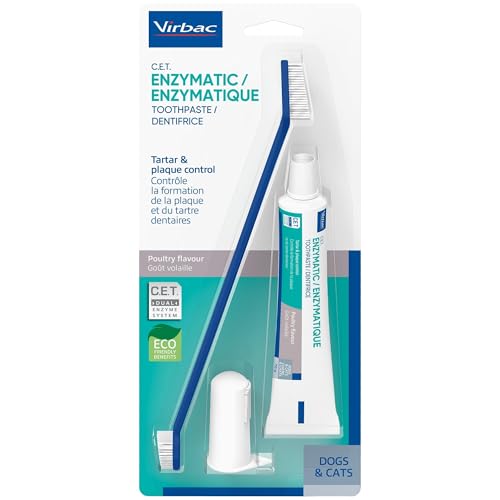
Start hereToothbrush and enzymatic paste kit
The highest-value purchase in this entire guide and among the cheapest. Buy poultry or malt flavor — the flavor is what makes step one of the routine work.
Check price on Amazon The paste itself
Enzymatic toothpaste (C.E.T. style)
If you already own a brush. Enzymatic pastes are formulated to be swallowed, which is the entire reason human toothpaste is off the table.
Check price on Amazon If brushing is a no
VOHC-accepted dental chews
Greenies and Purina DentaLife are the familiar accepted names. Match the size to your dog and count the calories against the daily portion — these are food, not accessories.
Check price on Amazon Zero effort layer
Dental water additive
The lowest-friction thing on this list: it goes in the bowl. Look for VOHC acceptance specifically, and watch that your dog keeps drinking normally for the first few days.
Check price on Amazon The bridge tool
Finger brush
For the middle stage of desensitizing, and for small dogs whose mouths a full brush head does not fit well. Less reach than a real brush, more than nothing.
Check price on Amazon For refusers
Dental wipes
Outer surfaces only, no gumline access, but genuinely easier on a dog that resents anything shaped like a brush. Some now carry the VOHC seal for tartar control.
Check price on AmazonDog dental care: FAQ
Is a professional dog teeth cleaning really worth the money?
For most dogs, yes, because it does something no home product does: scaling below the gumline, where periodontal disease actually lives, plus radiographs that find problems the eye cannot. The judgment call is timing and frequency, not whether to do it at all. Good at-home care is what stretches the interval and keeps extractions — the part that really inflates the bill — off the invoice.
Can dental chews replace brushing?
No. Studies consistently find toothbrushing is the gold standard and that no chew, diet or rinse currently on the market matches it for controlling periodontal disease. VOHC-accepted chews do produce a measured reduction in plaque or tartar, so they are a real intervention — they are just the fallback, and they work best alongside brushing rather than instead of it.
What does the VOHC seal actually mean?
That the product demonstrated a minimum reduction in plaque and/or tartar against untreated controls in a clinical trial of at least 28 days. It is awarded separately for plaque control and tartar control, so check which one a product carries. It is a threshold, not a ranking, and no seal puts a product on par with brushing.
Are anesthesia-free dental cleanings a cheaper alternative?
They are not an alternative. The American Veterinary Dental College strongly opposes the practice, and AAHA calls it below the standard of care. Scraping the visible surface does not touch subgingival disease, sharp instruments in a conscious dog's mouth risk injury, and the unprotected airway creates aspiration risk. The result is a cosmetic improvement that can mask a progressing problem.
Are antlers and bones good for a dog's teeth?
They are among the most reliable causes of fractured teeth that veterinary dentists see, and Cornell, the AVMA and AAHA all advise against antlers. Use the fingernail test — if your thumbnail leaves no mark, it is too hard for a tooth. A fractured carnassial needs extraction or a root canal under anesthesia, which costs far more than any chew saves.
How often should I brush my dog's teeth?
Daily is the target. Plaque begins forming within hours and hardens into tartar in a matter of days, so brushing a couple of times a week is barely ahead of not brushing. Thirty consistent seconds every night beats two thorough minutes twice a week.
My dog will not let me near their mouth. What now?
Spend a week on handling before any brush appears: paste off a finger, then lifting the lip, then a finger brush on outer surfaces only, then the brush. If you get through that and the answer is still no, move to a daily VOHC-accepted chew plus a water additive and plan on more frequent professional cleanings. That is a legitimate plan, just a more expensive one over the dog's life.
Related reading
The chew-hardness rule in this guide is the same one that governs toy buying — see best dog toys for aggressive chewers for the durable-but-not-tooth-breaking picks. Dental chews are food, so count them against the daily ration using our portion math guide. And if the desensitizing sequence above is a struggle, the same patience curve applies to the rest of the handling routine — how often should you bathe your dog covers building tolerance for that one.
This guide is research and veterinary-source synthesis, not a substitute for your own vet's exam. A dog with visible tartar, red gums, a broken tooth or genuinely foul breath needs an appointment, not a chew.