When Your Dog Keeps Slipping on Hard Floors: The Traction Kit, Layer by Layer
Yoga mats everywhere, socks that come off, toe grips the dog hates — owners of aging dogs cycle through the same fixes in the same order. What each layer actually does, what defeats it, and the one symptom that means vet first, gear second.
Some links below are affiliate links. If you buy through them, WoofTested may earn a small commission at no extra cost to you, including as an Amazon Associate, where we earn from qualifying purchases. We only recommend products that pass our Fit Analysis — and we publish the ones that don't.
Slipping is a two-variable problem — the floor and the dog — and the fixes that work attack the floor first. Nothing you attach to a dog stays attached as reliably as something you put on the ground.
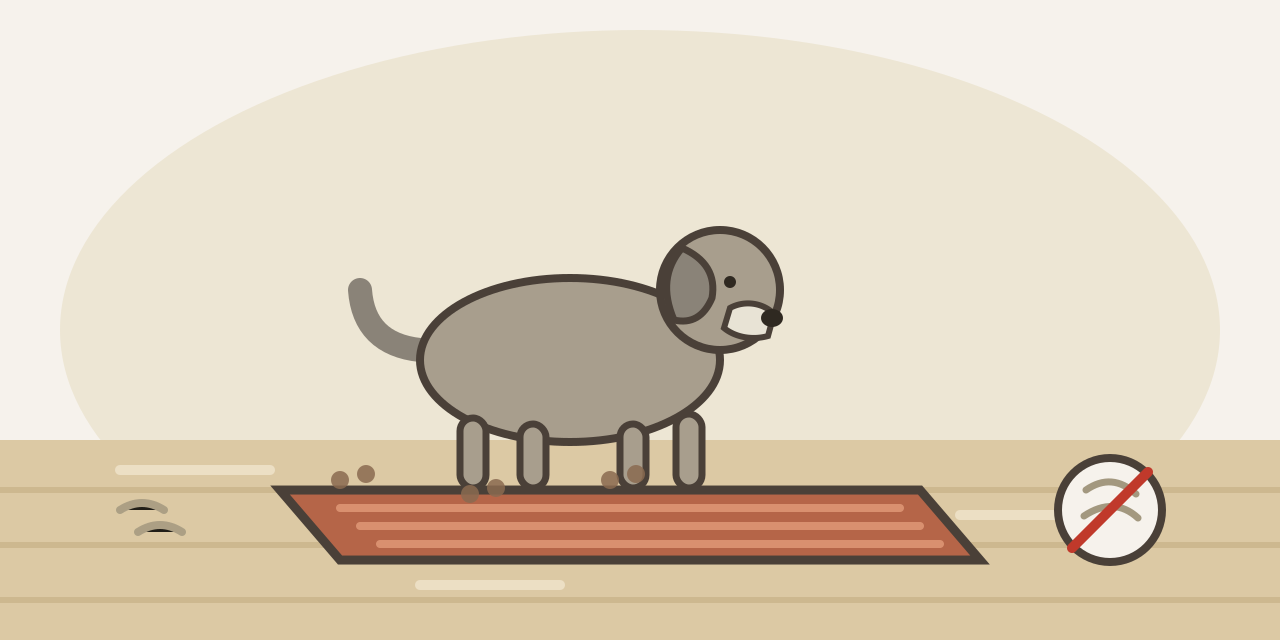
- Layer 1, the floor: rubber-backed runners on the routes the dog actually walks — bed to door, door to bowl, the turn into the kitchen. This is the highest-yield, zero-compliance fix. Owners reach for yoga mats, which work until they curl, slide, or — as one owner found — the other pet eats them.
- Layer 2, the feet: Dr. Buzby's ToeGrips for dogs that tolerate nail handling, non-slip socks for those that won't — each with a real failure mode we cover honestly below.
- Layer 3, the moments: a support harness with a lift handle for stairs and standing up, and a folding ramp for the car and couch, because the worst slips happen during transitions, not walking.
- First, the vet: slipping that arrived suddenly, or is one-sided, is a symptom, not a flooring problem. One thread this week described a 3-year-old lab losing her rear legs in a day — that is an urgent vet visit, and no product on this page is the answer to it.
Why this page exists
The threads arrive weekly and they rhyme. A 14-year-old pug, post-stroke, slipping on hard floors: the owner "laid yoga mats out for her everywhere," and the recently adopted cat is eating the mats. A 15-year-old golden with vet-confirmed arthritis adopting a crouched stance, still game for walks. An anxious senior whose clinginess tracks her declining footing. The owners are not asking whether their dog is aging — they know — they are asking which of the same five products actually works, because they have usually tried one, watched it fail, and concluded the whole category is junk.
It mostly isn't. Each layer works within its limits and fails outside them, and the failures are predictable enough to plan around. What follows is the kit organized by where it attaches — floor, feet, body — with the failure modes stated up front, because the pug owner's yoga-mat story is the normal experience, not the exception.
One register note before the products: WoofTested has not run a traction lab. What follows is a synthesis of owner reports, veterinary guidance on mobility support, and manufacturer specifications, labeled as such.
First, rule out the vet visit
Gear is for managed decline — the arthritis your vet already knows about, the old-age wobble that arrived over months. Three patterns mean the appointment comes before the shopping:
Sudden onset. The lab mix in this week's thread went from full-speed ball chasing to gingerly rear legs in a day. Sudden hind-end weakness has a differential — soft-tissue injury at the benign end, IVDD and other spinal problems at the urgent end — and speed matters for the bad ones. Slipping that appears overnight is a symptom.
One-sidedness. A dog compensating on one leg is not a traction problem.
Posture changes with the slipping. The 15-year-old golden's new crouch alongside his arthritis is exactly the kind of thing to show a vet before buying anything — pain management done well often improves footing more than any floor covering, because a dog in pain moves in ways that make slipping worse.
If your dog is already diagnosed and managed — the pug, the golden on meloxicam and gabapentin — then the rest of this page is for you.
Layer 1: the floor, which does most of the work
The reliable fix is the unglamorous one: put traction on the routes the dog walks. Not wall-to-wall — dogs are creatures of habit, and a week of watching will show you the actual map: bed to water bowl, bowl to back door, the sliding turn into the kitchen where momentum meets tile.
What to buy is less important than what it must have: a rubber or latex backing that grips the floor on its own. This is where the yoga-mat improvisation fails — mats are designed to grip under sustained human weight, not to stay put under a 4-legged scramble, so they migrate and curl at the edges, and a curled edge is its own trip hazard. Purpose-made non-slip runners in the 2-to-2.5-foot width are machine-washable, lie flat, and — relevant to the pug household — are considerably less appetizing to a bored cat than foam.
For the owner whose secondary problem is accidents, note the washable constraint is not optional: buy runners in multiples so one can be in the wash while its twin is on the floor. Skip foam interlocking tiles for incontinent dogs for the same reason — urine finds the seams.
Budget note: covering three routes costs less than most of the wearable options below and cannot be licked off, shaken off, or hated. Start here even if you also buy everything else.
Layer 2: the feet, with the objections handled honestly
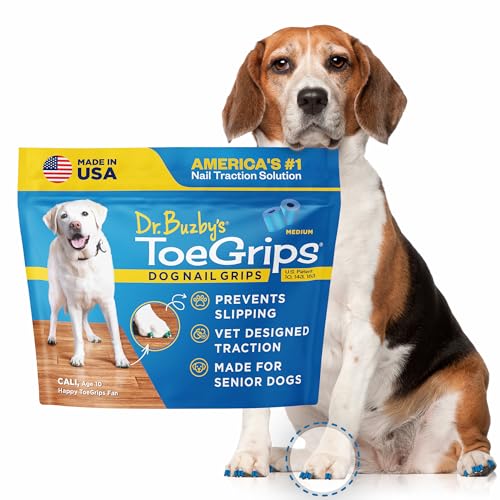
Dr. Buzby's ToeGrips are rubber rings that slide onto the nails, letting a dog whose paws mechanically slide on hard floors self-arrest the way nails-on-carpet would. They were developed by a veterinarian, they are the standard recommendation in senior-dog mobility circles, and the pug owner in this week's thread had already heard of them and balked: "I didn't really want to stick anything on her feet."
That objection deserves a straight answer rather than a sales pitch. What the hesitation usually means in practice: fitting requires handling every nail, they need repositioning as nails grow (the maker suggests re-checking roughly monthly), individual grips shed and get swallowed occasionally (they are designed to pass), and a minority of dogs obsessively lick them for the first day or two. If your dog resents paw handling, this is a real cost, and the honest alternative is more Layer 1. If your dog tolerates nail trims, ToeGrips are the least-clothing-like wearable option — nothing on the paw pad, nothing to take off at night. Size by nail width, not dog weight; each size is its own listing.
Non-slip dog socks are the other wearable, and their failure mode is the opposite one: dogs tolerate them fine, but they rotate, slide down, and come off — usually within hours, usually one at a time, usually under the couch. They also mute paw feel, which some unsteady dogs dislike. Where socks genuinely win: dogs whose paw pads themselves are the problem (dry, cracked, or fur-covered pads on breeds that grow slippery foot fur), and short supervised sessions rather than all-day wear. Trimming the fur between paw pads, incidentally, is a free fix that helps every dog with furry feet and costs five minutes with blunt-nose scissors.
Layer 3: the transitions, where the bad falls actually happen
Watch where an unsteady dog actually goes down: not mid-stride on the flat, but standing up from lying, turning at speed, stairs, and the leap in or out of a car. The last layer targets those moments.
A support harness with a real lift handle. The Ruffwear Web Master is the default here for a reason this page's sister thread made vivid: it is genuinely escape-proof (three straps, five adjustment points) and its padded handle is positioned over the dog's center of mass, so a human hand can take real weight on stairs or a slick stretch without wrenching the dog's spine. It is built for all-day wear, which matters — a mobility harness only helps if it is on when the dog stumbles. The honest caveat, reported by an owner in this week's harness thread: it is more gear than a flat-collar dog is used to, and some dogs need a treat-paced introduction before they stop dodging it. For dogs needing rear-end-only help, a rear support sling is the lighter tool for the bathroom-break walk.
A ramp for the repeated jumps. The PetSafe Happy Ride folding ramp — 62 inches deployed, 10 lb, rated to 150 lb, high-traction surface — turns the car leap into a walk. The trick nobody mentions: ramps require training before they are needed, with treats, on the flat, while the dog is still confident. A wobbly dog meeting a wobbly-looking ramp for the first time refuses it. Buy it a season early.
An orthopedic bed the dog can actually get off. Getting up is the hardest move an arthritic dog makes, and a deep marshmallow bed makes it harder. A true orthopedic foam bed with a firm, flat surface and a low front edge gives the legs something to push against. Place it off the slick floor — on one of your Layer-1 runners — so the first two steps after standing land on grip.
The kit, by problem
| What you're seeing | Start with | Why this first |
|---|---|---|
| Slipping on known routes, gradual onset | Rubber-backed runners on those routes | Highest yield, zero dog-compliance required, survives incontinence via the washing machine. |
| Slipping everywhere, tolerates paw handling | ToeGrips + runners | Traction travels with the dog; runners cover the worst zones while grips do the rest. |
| Hates paw handling, or pad/fur problem | Trim pad fur + grip socks for supervised sessions | Free fix first; socks accepted where nail handling is not, within their stay-on limits. |
| Struggles on stairs or standing up | Web Master harness, worn all day | The handle converts your hand into support at the exact moments falls happen. |
| Car and couch jumps getting hesitant | Folding ramp, trained early | Removes the highest-impact repeated jump before the first bad landing, not after. |
| Sudden, one-sided, or with posture change | Vet, today | That presentation is a symptom with a differential, not a traction problem. |
What we would buy
Selected on manufacturer specifications, veterinary mobility guidance, and consistent owner reports — including the failure reports. WoofTested has not bench-tested traction products; dimensions and ratings are the manufacturers' claims. Prices move constantly, so we do not quote them.
 Feet
FeetDr. Buzby's ToeGrips (Medium)
Vet-developed rubber nail rings that restore the self-arrest a dog would get from nails on carpet. Size by nail width — each size is a separate listing, so measure before ordering. Expect a monthly reposition check and the occasional shed grip; skip if your dog fights paw handling and put the budget into runners instead.
Check price on Amazon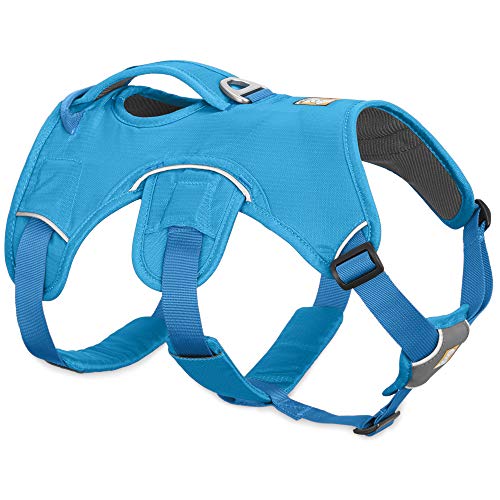 Body
BodyRuffwear Web Master harness (Medium)
The support harness that doubles as escape-proofing: three straps, five adjustment points, and a padded lift handle over the center of mass that takes real weight on stairs. Built for all-day wear. Listed at 0.6 lb. Some dogs need a slow, treat-paced introduction to this much gear — budget a week, not a minute.
Check price on Amazon Transitions
PetSafe Happy Ride folding ramp
62 inches deployed, folds flat, listed at 10 lb with a 150 lb rating and a high-traction walking surface — light enough to actually deploy every time, which is the spec that decides whether a ramp gets used. Train on it early, on flat ground, with food, before the dog needs it.
Check price on AmazonNail length undoes everything on this page. Overgrown nails tip weight back onto the paw's slippery rear pad and change the whole leg's geometry — on a senior dog whose walks have shortened, nails stop self-wearing exactly when footing starts failing, and the two decline together. Before evaluating any product's effect, get the nails to proper length and hold them there; every traction layer works better on a correctly trimmed foot, and some dogs need nothing else.
Dogs slipping on floors: FAQ
My dog started slipping suddenly. Which product should I start with?
None yet. Sudden-onset slipping — days, not months — is a vet visit first, because the causes range from minor strains to spinal problems where treatment speed matters. The gear on this page is for managed, diagnosed, gradual decline. If the vet clears the acute causes, come back to Layer 1.
Are toe grips cruel or uncomfortable? My dog hates things on her feet.
They are rubber rings on the nails, not the paw — nothing contacts the pad, which is where most foot-touch aversion lives. That said, fitting them requires calm handling of every nail, and a dog that fights nail trims will fight this. The honest answer for that dog is floor-side traction and pad-fur trimming, which need no cooperation at all.
Why do the socks keep falling off?
Because they are socks on an animal with no heel. Rotation and slide-down are inherent to the design; snugger sizing and socks with adjustable straps slow it but don't stop it. Treat socks as a supervised-session tool for pad-surface problems, not all-day equipment, and accept a lost-sock rate. If you need all-day traction on the dog, that is what ToeGrips are for.
Runner rugs everywhere feels like giving up my floors. Do I really need full coverage?
No — coverage should follow the dog's actual routes, which are fewer than you think. Watch for a week: most dogs commute between four or five stations. Covering those paths typically means three runners, not a houseful, and leaves the rest of the floor as floor. The aesthetic cost is real but smaller than the yoga-mat archipelago it usually replaces.
Will a support harness make my dog dependent on it?
The handle is there for moments — stairs, standing up, slick stretches — not for carrying the dog through life. Between assists it is just a well-fitted harness. Vets working in mobility generally encourage keeping arthritic dogs moving under their own power as much as safely possible; the handle's job is to make 'safely possible' cover more of the day, which supports activity rather than replacing it.
Related reading
If the slipping comes with a dog who has slowed down generally, the camera-first method in does my dog have separation anxiety? works just as well for telling boredom from discomfort in a slowing dog. Getting into the car safely is half ramp, half restraint — the restraint half is covered in what is actually crash-certified. And because gear only helps a dog that is otherwise comfortable, is dog teeth cleaning worth it covers the other quiet senior-dog maintenance decision owners defer too long.