How to Start Leaving a Puppy Alone: The Staged Plan Nobody Publishes
Everyone tells you alone time matters. Almost nobody tells you how to build it. Here is the progression from seconds to hours, the bladder ceiling you cannot train past, and the small amount of gear each stage actually needs.
Some links below are affiliate links. If you buy through them, WoofTested may earn a small commission at no extra cost to you, including as an Amazon Associate, where we earn from qualifying purchases. We only recommend products that pass our Fit Analysis — and we publish the ones that don't.
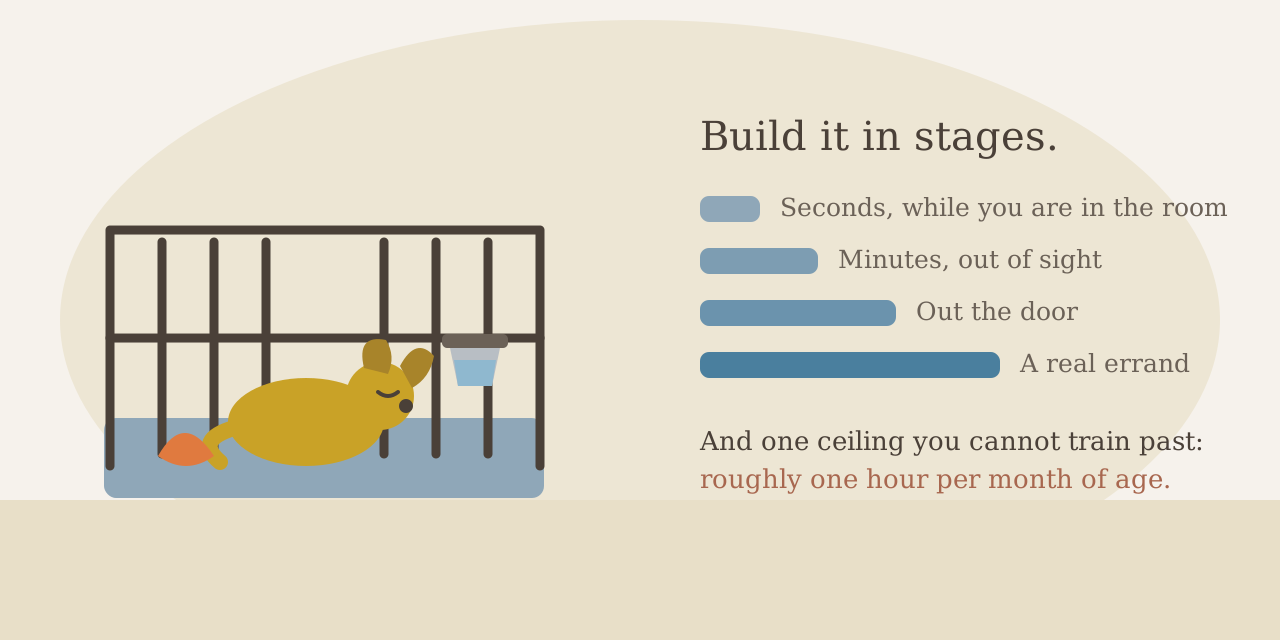
Two separate things limit how long a puppy can be alone, and only one of them is training. The trainable part is whether being alone feels safe. The untrainable part is a bladder. The American Kennel Club's guidance is that puppies under 10 weeks generally cannot hold it much beyond an hour, 10 to 12 weeks is about two hours, and from three months the rough rule is one hour per month of age, reaching around six hours by six months. No amount of practice moves that line, and most advice online quietly skips it.
Build the alone time in stages, starting from seconds. Not a first day out at work, not "leave them to cry it out." Step out of view for five seconds while they eat, come back before they notice, and grow it from there. The whole progression takes a few weeks of small sessions and is laid out below.
Set the space up so the puppy can be right. A pen rather than the run of a house, water they can actually reach, a washable floor, and one food-delivery toy that turns your departure into the best moment of the morning. That is most of it, and it costs well under $150.
And the honest part. If your working day is eight or nine hours with nobody home, that is not a gear problem and no product on this page fixes it. A young puppy needs a midday break from a person, whether that is you, a neighbour, a walker or daycare. We would rather say that plainly than sell you a feeder.

Why this guide exists
A new owner with a nine-week-old puppy, a crate and a pen already bought, put the problem better than any article we found:
There is endless writing about the importance of leaving puppies alone, and almost none about how to actually do it.
That is a fair complaint, and it is a real content gap. The advice that exists tends to be either a warning ("do not skip alone-time training") or a diagnosis of what happens when it goes wrong. The middle piece, the practical progression from a puppy who has never been alone to a puppy who sleeps through a two-hour absence, mostly does not get written down.
So that is what this is. It is a training and setup guide with a small amount of gear in it, not a shopping list with training sprinkled on top.
One thing before we start. WoofTested has not run any of this in a lab, and we are not a substitute for a trainer or a vet. What follows is the published guidance, put in an order you can actually follow.
The ceiling you cannot train past
Start here, because it decides whether the rest of the plan is even relevant to your week.
Two limits run in parallel. Emotional readiness is what you train: whether the puppy finds being alone unremarkable. Bladder capacity is what you cannot. A puppy who is perfectly relaxed alone still cannot hold urine longer than a puppy bladder holds urine, and asking them to do it does not build tolerance. It builds a puppy who has learned to go to the toilet indoors, which is a much harder problem to fix than the one you were trying to solve.
The AKC's guidance gives you the numbers:
| Age | Roughly how long they can hold it | |---|---| | Under 10 weeks | Often not much more than an hour | | 10 to 12 weeks | Around two hours | | 3 months and up | About one hour per month of age | | 6 months and up | Up to about six hours |
Veterinary behaviour guidance commonly caps the "one hour per month" rule at around four hours regardless of age, on the grounds that a dog needs more than an empty bladder to be all right.
Read the table as a hard ceiling on your plan and a soft target for your training. The training builds up to the ceiling. It never goes through it.
The progression, in four stages
The mistake almost everybody makes is starting at the wrong end: the first real absence is a full working morning, because that is when it first becomes necessary. The puppy's first experience of alone-ness is then four hours long, and it goes exactly as badly as you would expect.
Work in the opposite direction. Every stage below should be boring by the time you move on from it. If a stage produces distress, you have gone too fast, and the fix is always to go back a stage rather than to push through.
Stage 1: out of sight, seconds, while you are still home. Give the puppy something good in the pen, walk out of view, count to five, come back before they finish or start looking for you. Repeat several times a day at random moments. You are teaching one thing only: you leaving the room is not an event. Do not make a production of going or coming back, because the ceremony is what teaches them that departures matter.
Stage 2: out of sight, minutes, door closed. Same thing with a door between you. Build from thirty seconds to five, then ten, then twenty minutes. This is the stage most people rush, and it is the one that does the actual work. Vary it deliberately: sometimes come back at two minutes, sometimes at fifteen, so returning is unpredictable in a good way rather than a countdown.
Stage 3: out of the house. Now add the cues that predict a real departure, which the puppy has been quietly cataloguing: keys, shoes, coat, the front door. Pick up your keys and sit back down, twenty times, until they stop meaning anything. Then leave the building for two minutes and come back. Then five. Then twenty. This is where a camera stops being a gadget and starts being the only way to know what actually happens after the door closes.
Stage 4: a real absence. A genuine errand, inside the bladder ceiling from the table above. Do it on a day when a bad result costs nothing, not the first morning back at work.
How long does the whole thing take? For most puppies with a couple of sessions a day, a few weeks. It is not a lot of total time and it cannot be compressed into a weekend, because the variable that matters is number of calm repetitions rather than hours invested.
What each stage actually needs
| Stage | What you are teaching | What it needs |
|---|---|---|
| 1. Out of sight, seconds | Leaving the room is not an event | A pen and something good to chew |
| 2. Door closed, minutes | Being behind a door is fine | A stuffed food toy that outlasts the first minute |
| 3. Out of the house | Keys and shoes do not predict disaster | A camera, because you cannot see this stage otherwise |
| 4. A real absence | Nothing. Confirming the first three worked | Water in the pen, a washable floor, a realistic clock |
Set the space up so the puppy can get it right
The setup question is really a containment question, and there are three honest options.
A crate alone is right for sleeping and for short periods, and it is the wrong tool for the longest absence of your day. A crate is small by design, which is what makes it work as a den and as a toileting aid, and it is also what makes it unfair for hours at a stretch. Which crate is a separate decision, covered in our wire versus plastic versus soft crate guide.
A pen, or a pen with the crate inside it, is the setup that suits most puppies for most of the day. It gives a bed, a separate area to move around in, room for water, and space to toilet if the absence runs long, which is exactly what a crate cannot offer. The MidWest 30-inch pen is listed as 16 square feet of play area when configured as a square, 62 by 62 inches, and it folds flat when you want your room back.
A puppy-proofed room behind a gate is the next step up and is usually a later stage, not a starting point. More space means more to get into, and a puppy who is not yet reliable alone is not a puppy who should have a kitchen.
Whichever you choose, four things go in it:
- Water they can reach and cannot tip. This matters more than it sounds. One owner described watching on camera as her dog stayed in the crate all day and did not come out for water. Bowls that clip to the bars, at the puppy's height, solve the geometry version of that problem: the water is where the dog already is. If a dog is genuinely not drinking rather than simply not reaching, that is a vet conversation, not a shopping one.
- A washable floor. Accidents are part of the schedule at this age, not a failure of it. A large reusable pad under the pen means the accident costs a wash rather than a carpet, and takes the emotion out of it. The LOOBANI pads are listed at 36 by 48 inches, which covers most of a 62-inch pen's likely landing zone.
- One good thing to do, given at the moment you leave. More on this below.
- Nothing they can destroy and swallow. Unsupervised means unsupervised. Soft toys with stuffing, anything with a squeaker that can come out, and any chew small enough to swallow whole all wait until you are in the room.
Make the departure the best part of the morning
The single most useful trick in this whole area is to attach something excellent to the act of leaving, and to give it only then.
A frozen stuffed food toy does three jobs at once. It occupies the first ten to twenty minutes, which is the window where distress either starts or does not. Licking and chewing are self-soothing behaviours for dogs. And over a few weeks it changes what your keys predict, from "he is going" to "the good thing is coming."
Practical notes:
- Freeze it. A stuffed toy at room temperature lasts about ninety seconds. The same toy frozen solid can take twenty minutes or more, and twenty minutes is the difference that matters.
- Use their actual food. Soaked kibble, a little wet food, plain yoghurt or pumpkin. Puppies get fat quickly on extras, and there is no reason for this to be an added meal rather than part of an existing one.
- Give it and go. No goodbye, no reassurance ritual, no lingering in the doorway. Put it down, leave.
- Take it away when you get back. Its value comes from being unavailable at any other time.
- Check the size and the chewing style. A West Paw Toppl in the small size is listed at 7.1 by 5.5 by 3.2 inches and 0.26 lb, and it is dishwasher and freezer safe. If your puppy is already a determined chewer rather than a licker, look at our toys for aggressive chewers instead, and remember that unsupervised chewing has a higher safety bar than supervised chewing.
If your day is eight or nine hours with nobody home, no setup on this page makes that work for a young puppy, and we are not going to pretend otherwise. The bladder ceiling above is the reason: a twelve-week-old puppy has a two-hour bladder, and a feeder does not change that. What does work is breaking the day up with a person, whether that is a lunchtime trip home, a neighbour, a dog walker or daycare a few days a week. One of the owners whose question shaped this article had already bought the crate, the toys and the automatic feeder for nine-hour shifts and eventually cancelled the puppy instead. That was a hard call, honestly made, and it is a more responsible answer than most of what is written about this.
What about the dog who is never alone?
The opposite problem has become common, and it belongs here because the fix is the same skill in reverse.
If you work from home, your puppy may reach six months having genuinely never been by themselves. That is not neglect, it is the schedule, and it produces a dog for whom your first business trip is their first ever absence. One owner described a bored work-from-home dog who had stopped playing altogether, which usually says more about the shape of the day than about the toys in it.
Two things to do about it:
Practise alone time on purpose, even when you do not need it. Ten or twenty minutes behind a closed door, a few times a week, permanently. It is a skill and it decays if it is never used.
Separate work time from together time explicitly. A dog who spends nine hours next to your desk getting a hand on the head every twenty minutes is neither working nor resting, and boredom that gets low-grade attention all day still reads as boredom. Real settling, in a bed with something to chew, at set times, is more restful than constant low-level access to you.
If the concern is not "has not learned yet" but something sharper, a dog in real distress within minutes of you leaving, that is a different problem with a different fix. Our guide to whether your dog has separation anxiety covers the camera test that sorts the two apart, and it is worth doing before you spend anything, because the treatments pull in opposite directions.
The kit, in the order you need it
Chosen on published specifications and the guidance cited above. WoofTested has not tested these; dimensions and weights come from Amazon product data. Prices move constantly so we do not quote them. Buy the first two or three items and add the rest only if your plan needs them.
WoofTested PickMidWest folding exercise pen, 30 inch
The containment that suits most puppies for most of the day. Listed as 16 square feet of play area at 62 by 62 inches when squared off, 30 inches tall, 21.4 lb, with a walk-through door, and it folds flat for storage. Set it up around the crate rather than instead of it, so the crate stays a bed and the pen absorbs the length of the absence.
Check price on Amazon The departure toy
West Paw Zogoflex Toppl, small
Stuff it, freeze it, hand it over as you walk out. Listed at 7.1 by 5.5 by 3.2 inches and 0.26 lb, dishwasher safe and freezer safe, with interior prongs that hold food until it is worked out. Frozen, it covers the first fifteen to twenty minutes, which is the window that decides how the absence goes. Buy two so one is always in the freezer.
Check price on Amazon Fixes a real problem
Clip-on crate and pen water bowls, 2 pack
Stainless bowls with a bracket that clamps to horizontal or vertical bars at whatever height suits the dog, listed at 7.1 inches across. A tipped water bowl in a pen is a wet bed and a thirsty puppy, and a bowl mounted where the dog already sits removes both. Two in the pack, so one can be food and one water, or one can be in the wash.
Check price on Amazon Under the pen
LOOBANI washable pee pads, 36 x 48in, 2 pack
Reusable, absorbent, waterproof-backed and machine washable, listed at 36 by 48 inches. Two of them cover most of a 62-inch pen. The point is not just the floor: accidents are part of the schedule at this age, and a setup where an accident costs a wash instead of a carpet keeps you calm about it, which matters more for training than it sounds.
Check price on Amazon Stage 3 onward
Furbo 360 dog camera
You cannot train what you cannot see, and what a puppy does thirty seconds after the door closes is the entire question. A camera with two-way audio and treat tossing, listed at 2.29 lb, tells you whether your absences are calm or whether you have moved too fast. One caution: resist talking to a distressed puppy through it, since a disembodied voice with no person attached tends to raise the temperature rather than lower it.
Check price on Amazon Only if a person cannot be there
PetSafe automatic feeder, 5 meals
Five compartments of one cup each on a timer, listed at 12.6 by 4.4 by 16 inches and 3.9 lb, dishwasher-safe tray. Genuinely useful for a puppy on three or four meals a day when one falls in the middle of your working hours. Read the callout above before buying it, though: a feeder solves the meal, and it does not solve the bladder, the boredom or the company. It is a supplement to a person coming home, not a replacement for one.
Check price on AmazonLeaving a puppy alone: FAQ
How long can I actually leave my puppy alone?
Take the smaller of two numbers. The bladder limit, per AKC guidance, is roughly an hour under 10 weeks, about two hours at 10 to 12 weeks, then about one hour per month of age, reaching around six hours by six months. The training limit is whatever duration your puppy currently handles calmly, which at the start is measured in seconds. Work up to the first number and never past it. Veterinary behaviour guidance commonly treats four hours as a sensible cap for a young dog whatever the arithmetic says.
Should I use a crate or a pen when I go out?
A crate for sleeping and short periods, a pen for the longest absence of your day, and often both together with the crate inside the pen as the bed. The reason is that a crate is deliberately small, which is what makes it work as a den and helps with house training, and that same smallness is what makes hours in one unfair. A pen gives room to move, room for water, and somewhere other than the bed if the absence runs long. Which crate to buy is a separate question and we cover it in our crate guide.
Should I leave the TV or radio on?
It does no harm and may help a little, mostly by masking the outside noises that trigger barking rather than by being company. Do not expect much of it. It is well down the list behind a properly staged progression, a decent departure routine and an absence length that fits the dog. If your puppy reacts to hallway noise in a flat, sound masking is doing a specific job and is worth it. If they are distressed at being alone as such, it will not touch that.
My puppy cries when I leave. Do I go back in?
Not while they are actively crying, if you can avoid it, because going in at that moment teaches that crying works. But the more useful lesson is that they should not have got there at all: crying means the step was too long. Wait for a break in it, go in calmly without a greeting, and next time make the absence much shorter, back to a length that was boring. Repeated distress is not something to push through, and if a puppy panics within a minute or two every single time rather than settling, read our separation anxiety guide before continuing.
Is it cruel to get a puppy if I work full time?
Not automatically, and it depends entirely on whether the middle of the day has a person in it. Full-time work plus a lunchtime trip home, a walker, a neighbour or a few days of daycare is a workable arrangement that plenty of good owners run. Eight or nine hours with nobody at all is not workable for a puppy, and the honest thing is to sort that out before the puppy arrives rather than after. An older dog from a rescue, already house trained and used to being alone, is often the better fit for that schedule.
How do I know it is working?
Watch the first ten minutes on camera. A puppy who is doing well investigates, works on the food toy, potters, and then lies down and sleeps. A puppy who is not stays at the exit point, paces, whines in bursts rather than once, or does not touch food they would normally eat. Sleep is the signal you are looking for. Also watch what happens when you get back: a puppy who is genuinely fine gets up like you had never gone, while a frantic greeting every time suggests the absences are still too long.
Related reading
If you are still choosing the crate that goes inside the pen, start with wire versus plastic versus soft crates, which sorts the decision by your actual constraint rather than by type.
If you are worried that what you are seeing is more than incomplete training, does my dog have separation anxiety has the thirty-minute camera test that tells anxiety, boredom and unfinished alone-time training apart. Do that before you spend anything, because the three fixes pull in different directions.
And if the departure toy is getting destroyed rather than emptied, best dog toys for aggressive chewers covers what survives, with the reminder that unsupervised chewing needs a higher safety bar than chewing you are watching.