Wire vs Plastic vs Soft vs Ex-Pen: Which Dog Crate Fits Your Actual Problem (2026)
Almost every crate guide sorts by product. That is the wrong axis. A dog that bites the bars, a dog that will not settle, and a dog whose crate is eating a studio apartment need three different answers — and one of them is not a crate at all.
Some links below are affiliate links. If you buy through them, WoofTested may earn a small commission at no extra cost to you, including as an Amazon Associate, where we earn from qualifying purchases. We only recommend products that pass our Fit Analysis — and we publish the ones that don't.
Pick the crate that solves your specific failure, not the one with the best reviews. Four constraints cover almost everyone:
- Your dog bites or paws at the bars → move to a solid-sided plastic kennel or drop the crate entirely for an ex-pen. A mouth on a wire grid is the one failure mode where the crate design itself is the hazard.
- Your dog will not settle in it → the crate is probably fine and the setup is not. A cover, a proper pad, and moving it into the room you actually sleep in fixes more of these than a new crate does.
- The crate is eating your floor space → the spec to buy on is folded depth, not assembled size. A folding wire crate collapses flat; a plastic kennel does not.
- You need it for the car, the vet, or a flight → plastic, and check the airline's rules before you buy anything.
The default, if you have no specific problem: a double-door folding wire crate with a divider panel. It is the cheapest way to buy one crate that fits a puppy at 10 weeks and the same dog at two years, and it folds away when you are done with it.

Why "which crate is best" is the wrong question
Crate threads all collapse into brand arguments, and the arguing is beside the point. Owners asking this question are not really asking about materials. They are asking about one of four situations, and each one has a different answer:
A puppy owner whose 11-week-old got its jaw caught in the bars and screamed. An owner of a 12-week-old who will not sleep in the thing at all. Someone at 14 months wondering whether the crate can go into storage and give a small apartment its floor back. And someone who feels guilty about crate hours and wants to know what normal looks like.
Those are four different purchases: a crate with no bars, a crate accessory, a folding mechanism, and nothing at all. Sort by the constraint and the product falls out of it. That is how this guide is arranged.
One register note before the recommendations: WoofTested has not bench-tested crates. What follows is spec comparison against manufacturer listings plus a synthesis of what owners consistently report. Where a crate design has a genuine safety consideration, we say what it is and leave the judgement with you.
Your constraint, and what it points at
| The problem you actually have | What to buy | Why |
|---|---|---|
| Dog mouths, bites or paws at the bars | Solid-sided plastic kennel, or an ex-pen | Removes the grid a jaw or paw can get through |
| Dog will not settle, cries, stays alert | Cover + a real pad, and relocate the crate | Usually a den problem, not a crate problem |
| Small apartment, crate dominates the room | Folding wire crate, or ex-pen you take down daily | Folded depth is the spec; plastic does not fold |
| Growing puppy, do not want to buy twice | Wire crate with a divider panel | One purchase covers 10 weeks to adult size |
| Car travel, vet trips, possible flying | Plastic kennel, airline-rated size | Rigid shell; wire and soft are not accepted as cargo |
| Settled adult dog, occasional use, trips away | Soft crate | Light and packs down; not containment for a chewer |
| Dog is genuinely destructive when confined | Stop and read the separation-anxiety section first | Confinement can make panic worse, not better |
The four types, and what each actually gives you
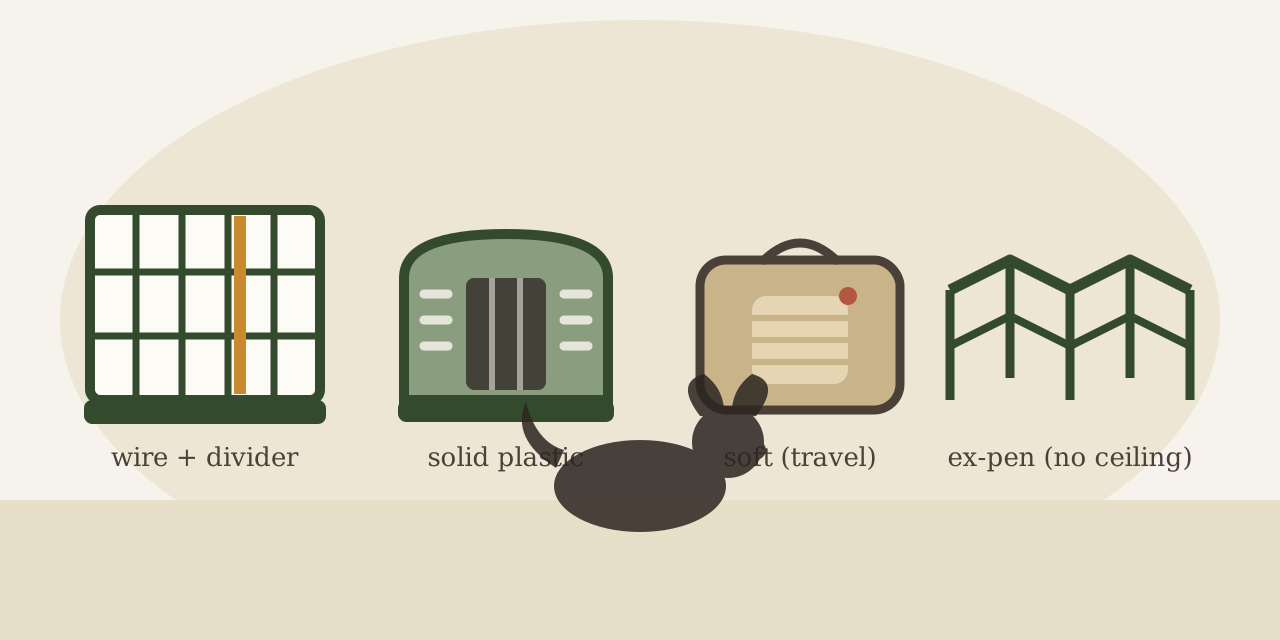
Folding wire crates. The default for a reason. Airflow on all sides, a slide-out tray you can hose off, and — the feature that matters most financially — a divider panel so a single 36" crate can be walled down to puppy size and opened up as the dog grows. Sizing is published by weight band: roughly 24" up to 20 lb, 30" for 21-40 lb, 36" for 41-70 lb, 42" for 71-90 lb, 48" above that. Double-door versions cost a little more and are worth it in a room where only one wall works. They fold flat, which is the entire answer to the apartment question.
Plastic kennels. A rigid shell with a wire door and ventilation slots on the sides. What you gain is no grid to chew or get stuck in, a darker and more enclosed interior, and the only format airlines will accept in cargo. What you give up is airflow, visibility, and the ability to store it flat — a plastic kennel is a permanent piece of furniture in a way a wire crate is not. Most split into two halves for storage; that is not the same as folding.
Soft crates. Steel tube frame, heavy fabric and mesh panels, zip doors, folds down to a few inches. Genuinely excellent for a settled adult dog you take to friends' houses, camping, or agility. Not containment. A dog that chews, digs, or is motivated to leave will be out of a fabric crate, and there is no version of this you can shop your way around. Buy one for convenience, never for security.
Ex-pens. Not a crate at all — a folding wire fence, typically eight 24"-wide panels enclosing about 16 square feet, in heights from 24" to 48". This is the format most often missing from crate guides and it is the right answer more often than people expect: no ceiling, no enclosed box, far more floor, and you can attach it to a crate door to make a crate-plus-yard. For a puppy that panics in enclosed spaces, or an owner who is uneasy about crating at all, an ex-pen is the honest middle. Buy taller than you think — a determined adolescent clears a 24" pen.
If your dog bites the bars
This is the one where the crate design is the problem rather than the dog.
Owners of fine-boned and narrow-muzzled breeds — sighthounds especially — periodically report the same incident: the dog mouths the wire, gets its lower jaw or a canine hooked around a bar, and panics. One owner of an 11-week-old described the dog getting stuck this way and screaming. We are reporting that as an owner account, not as a tested finding or a claim about any particular manufacturer, and the honest read is not "wire crates are dangerous" — millions of dogs use them uneventfully. It is narrower and more useful than that: if your dog puts its mouth on the bars, the wire format has stopped being suitable for that dog.
Two real options:
A solid-sided plastic kennel. Nothing to get a jaw around. The wire door is the only grid, it is a much coarser one, and it is at the front where the dog is usually facing rather than lying against. This is the straight swap and the one most people should make.
An ex-pen. Counter-intuitive but often better: a lot of bar-biting is a dog trying to get out of an enclosed box. Remove the ceiling and the reason frequently goes with it. Downside is that a pen contains less — it is a boundary rather than a box.
What is not a fix: a bigger wire crate, or a cover over a wire crate. Neither removes the grid. And if the bar-biting comes with drooling, frantic escape attempts and damage focused on the door, you may be looking at confinement panic rather than a hardware problem — our separation anxiety guide has the 30-minute camera test that tells those apart, and it is worth running before you buy anything.
If your dog will not settle in it
A 12-week-old that will not sleep in the crate is the single most common crate complaint, and it is almost never solved by a different crate.
Move it first. The most effective change costs nothing: put the crate in your bedroom, next to the bed, for the first several weeks. A puppy that has never slept alone in its life is not objecting to the crate, it is objecting to being alone. Bedroom first, then move it out by degrees once settling is reliable.
Then cover it. A fitted cover turns an open wire box into a den, and it stops visual triggers from restarting the dog every time something moves in the hallway. Buy a proper fitted one rather than throwing a blanket over — the manufactured covers have side flaps that roll up, so you can control ventilation and light instead of choosing between fully covered and not. Do not cover a plastic kennel; it is already enclosed and airflow is its weak point.
Then give it a real floor. A bare plastic tray is cold and loud. A crate pad is not a comfort upgrade so much as the thing that makes lying down more attractive than pacing. For a dog that scratches and digs at bedding, ripstop-style crate pads are built for that; be honest with yourself about which side of "mild chewing" your dog is on, because no pad survives a committed destroyer and a swallowed piece of foam is a much bigger problem than a chewed bed.
Then check the size. An oversized crate is a real cause of unsettled puppies and of one end becoming a toilet. The dog should be able to stand without ducking, turn around, and lie fully stretched — and not much more than that. That is exactly what the divider panel is for.
If the crate is eating your apartment
At around a year, plenty of owners look at a 36" or 42" box in a small living room and start doing floor-space arithmetic. Two honest points.
Retiring the crate is a legitimate outcome, not a failure. A settled adult dog with reliable house manners does not need a crate. The reasonable path is gradual: leave the door open, then remove the crate for short absences, then longer, watching for regression. Keep it retrievable rather than selling it — illness, recovery from surgery, and house moves all bring the crate back.
If it is staying, buy for folded depth. This is the spec nobody publishes prominently and everyone should shop on. A folding wire crate collapses to a few inches and slides behind a sofa or under a bed. A plastic kennel splits into two nested halves and still occupies a corner. A soft crate folds to roughly three inches and goes into a closet, which is why it is the format that survives in genuinely small flats — with the caveat above that it contains almost nothing.
The alternative worth considering: an ex-pen instead of a crate. It takes ninety seconds to fold down and store completely flat, which means it exists only while it is being used. For a small apartment with an adolescent dog, "gone by day, up at night" beats any crate that is permanently in the room.
What to buy, by constraint
Sizes below are the mid-range ones; check the weight band on the listing against your dog's adult weight, not its current weight. Prices move, so we do not quote them.
WoofTested PickMidWest iCrate 36", double door + divider
The default. Divider panel means one crate covers a puppy through to a 41-70 lb adult, two doors give you more placement options, and it folds flat when the dog outgrows the need. 30" and 42" versions cover the bands either side.
Check price on Amazon For 21-40 lb adults
MidWest iCrate 30", double door + divider
Same crate, the size band most spaniels, terriers and mid-size mixes finish in. Buying by adult weight and using the divider is cheaper than buying twice.
Check price on Amazon For bar-biters and car travel
Petmate Vari Kennel, 28"
Solid plastic shell, wire front door, ventilation on all four sides, assembles without tools. The straight swap when a wire grid has become a hazard, and the only format that travels as airline cargo. 36" version for larger dogs.
Check price on Amazon Larger solid-sided option
Petmate Vari Kennel, 36"
Same design, sized for larger dogs. Check your airline's specific kennel rules before buying for a flight — carriers publish their own dimension and hardware requirements and they differ.
Check price on Amazon The crate alternative
MidWest folding exercise pen, 30" tall
Eight 24" panels enclosing about 16 sq ft, folds completely flat, attaches to a crate door if you want a crate-plus-yard. The right answer for a puppy that panics in an enclosed box, and for anyone who would rather not crate at all. Go taller than 30" for an athletic adolescent.
Check price on Amazon Travel only
EliteField 3-door soft crate, 36"
Steel tube frame, 600D fabric and mesh, three zip doors, folds to about three inches with a carry bag. Excellent for a settled adult away from home. Not containment for a chewer or an escape artist, and no version of it is.
Check price on Amazon Fixes "won't settle"
MidWest crate cover, 36"
Fitted polyester cover with roll-up side flaps, machine washable, sized to standard 36" crates. Lets you control light and ventilation instead of choosing between a blanket over everything and nothing. Wire crates only.
Check price on Amazon For diggers and scratchers
K9 Ballistics Tough Ripstop crate pad, 30"
Ripstop shell over 1.5" of fill with a non-skid backing, machine washable. The maker rates it for scratching, digging and mild chewing — that wording is doing real work, so if your dog opens bedding and eats it, take the bedding out instead. 41 x 27 version fits 42" crates.
Check price on AmazonSizing, without the guesswork
Two rules do all the work.
Buy for the adult dog and divide down. Crate listings are published in weight bands and the band is the useful number: 24" up to about 20 lb, 30" for 21-40, 36" for 41-70, 42" for 71-90, 48" above. Look up the adult range for your breed or your rescue's best guess, buy that, and use the divider panel to wall it down to puppy size on day one.
Then check it against the dog, not the box. Standing without ducking the head, turning around comfortably, lying fully stretched on one side. If the dog can do all three and there is not enough spare room for a separate toilet corner, the size is right. Too big is a real problem, not a kindness — a puppy that can soil one end and sleep in the other will, and house-training gets harder.
Borderline between two sizes? For a wire crate with a divider, size up. For a plastic kennel, which has no divider, size to the dog you have now if it is a puppy you will replace the kennel for anyway, or to the adult if you are buying once.
A crate is a management tool for a few months, not a life sentence or a moral failing. The common guideline for puppies is roughly one hour of crate time per month of age between breaks — a 12-week-old at about three hours — and no dog of any age should be doing eight-hour stretches as a routine. If the maths on your working day does not add up, the fix is a midday walker or an ex-pen with a toilet area, not a bigger crate.
Dog crates: FAQ
Wire or plastic crate — which is better?
Wire for almost everyone: better airflow, a divider that grows with the dog, and it folds flat for storage. Plastic wins in three specific cases — a dog that bites or catches on the bars, a dog that settles better in a fully enclosed space, and any travel involving an airline. It is a constraint decision, not a quality one.
Can I raise a puppy without a crate?
Yes, and plenty of people do. You still need confinement of some kind while house-training and while the dog cannot be trusted alone with your skirting boards, but an ex-pen or a puppy-proofed room does that job. What you lose is a portable, familiar space for vet stays, car travel and recovery from surgery — situations where a dog that has never been crated has a much harder time.
My puppy screams in the crate. Do I need a different one?
Usually not. Try the setup changes first: move the crate next to your bed, add a fitted cover, put a proper pad in it, and check the size is not far too big. Feed meals in the crate with the door open so it predicts good things. If the distress is immediate, extreme and focused on escaping — drooling, damaged door, injured mouth or paws — stop and treat it as a confinement or separation problem rather than a crate-shopping one.
How long can a dog stay in a crate?
The widely repeated guideline for puppies is about one hour per month of age between breaks, so around three hours at 12 weeks, up to a ceiling of roughly eight hours for an adult — and eight is a ceiling, not a target. Overnight sleep is a separate case and counts differently, because the dog is asleep and you are in the house.
Is an ex-pen safer than a crate?
Different, not automatically safer. A pen removes the enclosed box and the bar grid, which matters for dogs that panic or mouth the wire. But it also has no ceiling, so an athletic dog can climb out, and it contains less if the dog is destructive. Height is the spec that decides it: buy taller than you think you need.
Do I need a crate pad, or is a blanket fine?
A blanket is fine for many dogs and much easier to wash. A purpose-made pad is worth it if your dog scratches and digs at bedding, since ripstop shells hold up where a blanket shreds. For a dog that actively eats fabric, the right answer is a bare tray — ingested bedding causes obstructions, and that is a surgical problem rather than a laundry one.
Related reading
If the crate problem is really a destruction problem, start with does my dog have separation anxiety — the camera test in it separates panic from boredom, and the two need opposite fixes. For dogs that treat everything as a chew including their bedding, our durable toy shortlist covers what holds up and what vets keep removing from X-rays. And if crate time is long because meals are over in nine seconds, a slow feeder buys back some of that.