Front-Clip vs Back-Clip vs Head Halter: What Each One Actually Does
No-pull gear does not train a dog and no harness makes pulling stop. What it does is change where the force goes, and each design trades something real to get it. Here is the tradeoff each one makes, including the one the research complicates.
Some links below are affiliate links. If you buy through them, WoofTested may earn a small commission at no extra cost to you, including as an Amazon Associate, where we earn from qualifying purchases. We only recommend products that pass our Fit Analysis — and we publish the ones that don't.
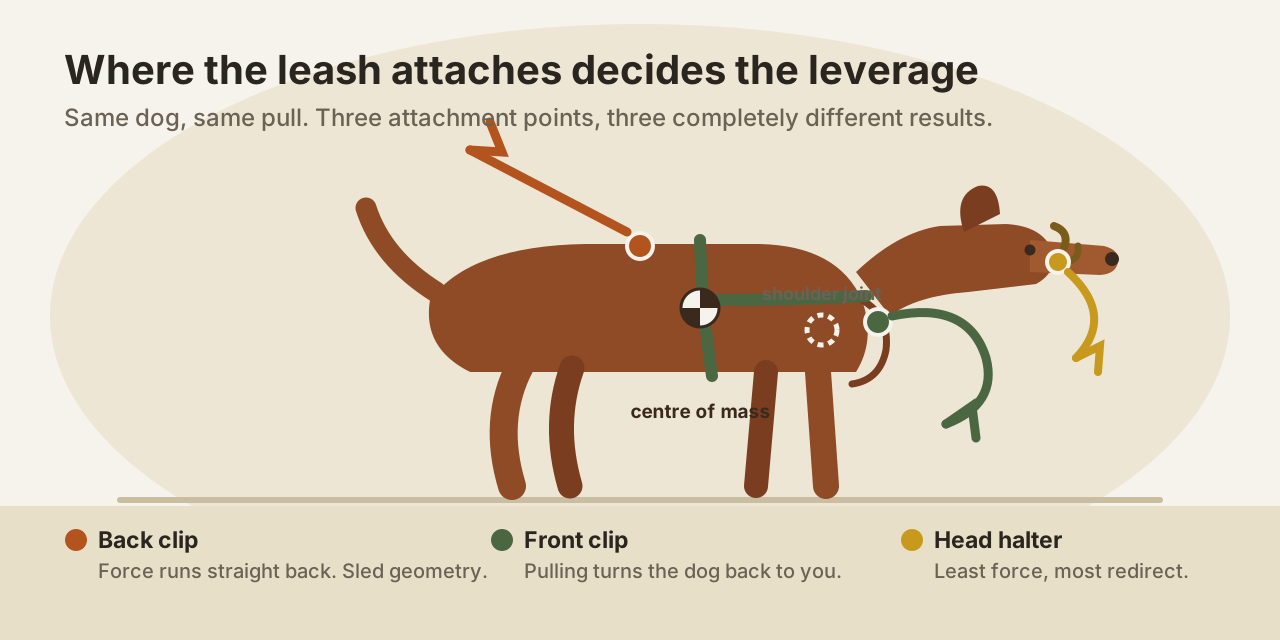
Attachment point decides leverage, and leverage is the whole game. A back clip sits behind the dog's centre of mass, so pulling into it is mechanically comfortable and the dog gets a sled-dog geometry. A front clip sits ahead of it, so pulling turns the dog back toward you instead of driving forward. A head halter controls the head, and where the head goes the body follows, which is why it gives the most control per pound of handler strength.
Our default recommendation is a dual-clip harness with a double-ended leash, which is what most professional trainers actually use: front clip for steering, back clip for stability, and the ability to change the balance mid-walk. The 2 Hounds Design Freedom ships as exactly that setup.
A head halter is the right answer in one specific case: a genuine strength mismatch, where the dog can physically out-muscle the handler and safety is the issue. It comes with real conditions attached, and we set them out below rather than burying them.
And the thing almost every guide gets wrong: the published biomechanics research does not cleanly support "Y-shaped good, chest strap bad." Where the straps sit relative to the shoulder joint matters more than the shape on the packaging. Fit beats type.
None of this trains a dog. Equipment buys you the physical ability to manage the walk while the training happens.
Why we built this page, stated honestly
We want to be straight about the evidence behind this guide, because we ask products to be honest with us.
This page exists because walking gear was the largest hole in our coverage, not because our community listening produced a wave of demand for it. The signal we did see was oblique: an owner asking what they should have done differently when they could not get a 10-month-old dog's attention off an approaching off-leash dog. That is a control problem, and control equipment is part of the answer, but it is one thread and we are not going to dress it up as a groundswell.
So treat what follows as what it is: a structured research synthesis of how these designs work mechanically, what the published literature says about their effects on movement, and where the tradeoffs land. Our recommendations use the WoofTested Fit Analysis, which is a disclosed research and scoring framework and explicitly not an in-home test. We have not put these harnesses on dogs.
The mechanics, in one idea
Everything about no-pull equipment follows from one thing: where the leash attaches relative to the dog's centre of mass.
When a dog pulls against a fixed point behind its shoulders, the geometry is the same one used deliberately in sled harnesses. The force runs straight back along the spine, the dog is braced against it, and the harder it pulls the more stable it feels. There is also a reflexive component: push into a dog and it tends to push back, which is why pressure directly opposing forward motion often produces more forward motion rather than less.
Move the attachment point to the chest and the geometry inverts. Pulling now creates a turning moment. The dog's own force rotates its front end back toward the handler, so pulling produces the opposite of progress. Nothing has to hurt for this to work, which is the design's real virtue.
Move it again to the head and you get the largest mechanical advantage available, because the head leads the body and a small force applied there redirects the whole dog. That leverage is also exactly why a head halter demands more care than the other two.
One consequence worth stating plainly: none of these three teaches a dog not to pull. They change what pulling accomplishes, which makes the walk manageable and creates the conditions for training. A dog walked on a front clip for two years without any training will usually still pull the day you put a flat collar back on.
The three designs, and what each one costs you
| Design | What it gives you | What you give up | Best for | Roughly |
|---|---|---|---|---|
| Back clip | Comfort, no interference with the head, nothing to condition the dog to | Leverage. It is the worst geometry for a dog that pulls hard | Dogs that already walk politely, small dogs, and any dog with a neck or trachea issue | $20 to $50 |
| Front clip | Redirects pulling into a turn using the dog's own force. Works immediately, no aversive component | Some restriction of shoulder movement, depending on where the straps sit. Leash can swing under the legs | The default for most pullers | $25 to $45 |
| Dual clip plus double-ended leash | Both of the above, adjustable mid-walk. What most trainers use | A second attachment to manage and a slightly higher price | Almost everyone. This is our default | $35 to $60 |
| Head halter | The most control per pound of handler strength, by a wide margin | Real conditioning time, most dogs dislike it initially, and a genuine injury risk if used wrong | Strength mismatches where safety is the actual issue | $20 to $35 |
The part the research complicates
Here is where this page departs from most of what you will read.
The standard advice is that Y-shaped harnesses are the ethical choice because they leave the shoulder free, and that harnesses with a horizontal strap across the chest restrict the shoulder and should be avoided. It is repeated everywhere, it is intuitive, and the published work does not support it as cleanly as the slogan suggests.
Studies looking at harness design and forelimb movement, including work published in the Journal of Applied Animal Welfare Science in 2023 and a systematic review of harness and head-collar biomechanics, have found reductions in shoulder extension on the order of eight to ten degrees across harness designs, with the Y-shaped designs marketed as non-restrictive performing no better than the chest-strap designs they are sold against, and in some measurements worse. The variable that mattered was where the straps actually sat relative to the shoulder joint, not the silhouette on the packaging.
Two honest caveats about that literature, because it deserves them. These are small-sample studies, often done on treadmills, and treadmill gait is not street gait. And a reduction in shoulder extension measured over a few strides is not the same thing as a demonstrated injury; the concern is that sustained gait changes could contribute to soft-tissue problems over time, which is a reasonable worry rather than an established outcome. We have not reproduced any of this work and we are citing it, not confirming it.
What it means practically is more useful than the slogan it replaces:
Fit is the variable you control, and it matters more than the type. A well-fitted chest-strap harness sitting above the shoulder joint interferes less than a badly fitted Y-harness whose straps have slipped down across it.
Check where the strap sits, on your dog, standing. The front strap should sit across the breastbone, above the point of the shoulder, not draped across the moving joint. If it rides low, tighten the neck section or size down.
Adjustability is a feature worth paying for, especially for a deep-chested, barrel-chested or otherwise awkwardly proportioned dog, because the harness that fits the average dog off the shelf may be the one that sits wrong on yours.
Watch the dog move. A shortened front stride, a hitch, or reluctance to trot in a harness the dog walks fine without is worth taking seriously regardless of what the box says.
Head halters: the case for, and the conditions attached
Head halters get recommended too casually and dismissed too casually, and both are wrong.
The case for. If your dog can physically overpower you, no harness fixes that, because a harness still lets the dog apply its full body weight against you. A head halter changes the mechanics so completely that a small handler can manage a large strong dog safely. When the alternative is a person who cannot hold their dog near traffic or other dogs, that is not a comfort question, it is a safety one, and the halter is the right tool.
The conditions, none of which are optional.
Condition the dog to it properly, over days. Almost every dog paws at a head halter at first and many will try to rub it off. The failure mode is a person who puts it on, walks out the door, and concludes the dog hates it. Introduce it in short sessions with food, at home, with no walk attached, until the dog is neutral about wearing it.
Use a short leash. Never a long line, never an extending leash. This is the safety rule that matters most. A dog that hits the end of a long leash at speed while wearing a head halter takes that force through its head and neck, which is a real injury risk. On a short leash the dog cannot build up that momentum.
Never jerk or correct with it. The leverage that makes a halter effective is the same leverage that makes a sharp pull on it dangerous. Steady guidance only.
Fit the nose loop correctly so it sits high on the muzzle and the dog can still open its mouth, pant and take treats. A halter is not a muzzle and must never restrict those.
It will not fit a short-muzzled dog. Pugs, bulldogs and similar flat-faced breeds have nothing for the nose loop to sit on. Use a front-clip harness instead.
One more thing worth saying, since WoofTested publishes what it will not recommend: we do not recommend prong, choke, shock or spray collars in any context on this site. The mechanical alternatives above solve the control problem without a pain or startle component, and that is the standard we hold.
Equipment is management, not training. The thread that prompted this page was an owner whose 10-month-old dog could not disengage from an approaching off-leash dog. A front-clip harness would have helped that handler physically move the dog, and it would not have produced attention. Those are different problems with different solutions, and gear only solves the first. If your dog cannot disengage from triggers, the harness buys you safe handling while you work on the training with a qualified force-free trainer. Buying gear instead of training is the most common expensive mistake in this category.
What to buy, by situation
Selected on published design specifications, adjustability, and how each fits a real handling problem, using the WoofTested Fit Analysis. That is structured research and scoring, explicitly not an in-home test: we have not fitted these to dogs. Sizing is the single biggest determinant of whether any of these works, so measure your dog's girth behind the front legs and check it against the maker's chart before ordering, and check the size on the listing before you buy since these come in several.
 WoofTested Pick
2 Hounds Design Freedom No-Pull, harness and leash set
The setup most trainers actually use, sold as one package: a dual-clip harness with a front ring for steering and a back ring for stability, plus the double-ended leash that lets you use both at once and shift the balance mid-walk. The back martingale loop tightens gently across the chest rather than the throat. Made in the USA and available in several widths, so the 1 inch version suits medium and large dogs while narrower widths cover smaller ones.
Check price on Amazon Cheapest thing that works
PetSafe Easy Walk Harness
The front-clip harness most people meet first, and it earns its place: the martingale front loop redirects pulling on the first walk with no conditioning period and no aversive component. Its known weakness is the one the biomechanics discussion is about, since the horizontal chest strap can settle low across the shoulders if the neck strap is left loose. Worth buying with that in mind: set the neck section so the front strap rides across the breastbone, then check it again after a week of wear.
Check price on Amazon Best for hard-to-fit dogs
Blue-9 Balance Harness, reflective buckle-neck
Six independent points of adjustment, which is the specific answer to a deep-chested, barrel-chested or otherwise oddly proportioned dog that nothing off the shelf sits right on. Given that fit rather than harness type turns out to be the variable that decides whether straps clear the shoulder joint, adjustability is the feature most worth paying for here. The buckle neck means you are not pulling it over the dog's head each time, which matters for head-shy dogs. Dual clip.
Check price on Amazon Best everyday harness
Ruffwear Front Range
The one to buy if your dog does not pull hard and you want a comfortable, durable harness for daily walks that still has a front ring for the days it is needed. Padded, reflective, four points of adjustment, and built to a standard that survives years rather than seasons. It is not the strongest anti-pull tool on this page and it does not need to be; it is the harness for a dog whose walking is basically fine.
Check price on Amazon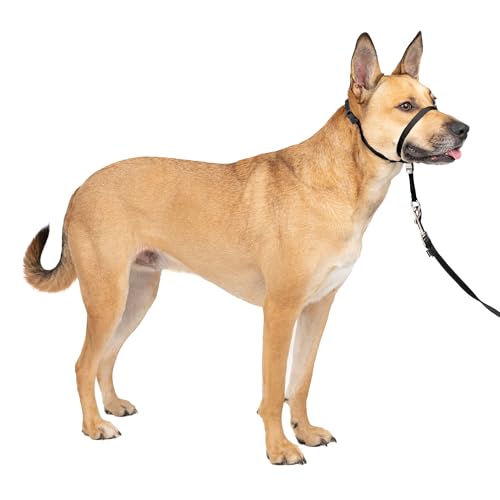 For a genuine strength mismatch
PetSafe Gentle Leader headcollar
The head halter to buy if you need one, designed by a veterinary behaviorist, with a padded neoprene nose loop and a quick-snap neck strap. Buy it only if you have read the conditions above and will follow them: days of conditioning before the first real walk, a short leash and never an extending one, no jerking, and a nose loop fitted so the dog can pant, drink and take treats. It will not fit a short-muzzled dog. Used properly it is the most effective control tool here; used casually it is the one most likely to go wrong.
Check price on Amazon If your harness has two rings
Halti double-ended lead
The piece most people are missing. A dual-clip harness only does its job if the leash can reach both rings, and this is the standard way to do that: clip the front for steering and the back for stability, and adjust the balance without stopping. It also shortens and lengthens for road walking versus open space, and doubles as a hands-free lead. Cheap, and it upgrades a harness you may already own rather than replacing it.
Check price on AmazonFitting it, which decides whether any of this works
A harness that fits badly is the most common reason no-pull gear disappoints, and it is entirely within your control.
Measure girth first, around the deepest part of the chest just behind the front legs, and check it against the maker's chart rather than guessing from your dog's weight. Two 50 lb dogs can be two sizes apart.
Two fingers is the standard. You should be able to slide two fingers flat under any strap. Tighter restricts movement and rubs; looser lets the harness rotate, which is both an escape risk and the thing that drags the front strap down across the shoulder.
Check where the front strap sits with the dog standing square. Across the breastbone, above the point of the shoulder. If it has crept down onto the moving joint, the neck section is too loose.
Re-check after a week, and after any coat change. Straps settle, buckles creep, and a dog blowing its coat can change effective girth noticeably.
Watch for rubbing in the armpits, which is the most common sore spot and usually means the chest strap is too far back or the harness is a size too small.
And for a growing dog, expect to re-measure every few weeks. A harness bought for a 10-month-old will not still fit correctly at 14 months, which is worth factoring into what you spend.
No-pull harnesses: FAQ
Will a no-pull harness stop my dog pulling?
It will stop pulling from working, which is different and is most of what you need day to day. A front clip turns forward force into a turn, so the dog stops making progress by pulling and most dogs ease off quickly. What it does not do is teach loose-leash walking. Take the harness off and put a flat collar on and an untrained dog pulls exactly as before. Think of it as management that makes walks possible while training happens, not as a substitute for the training.
Is a front-clip harness bad for a dog's shoulders?
The honest answer is that published studies have found measurable reductions in shoulder extension with harnesses generally, on the order of eight to ten degrees, and that the Y-shaped designs marketed as the solution did not clearly outperform the chest-strap designs they are sold against. Strap position relative to the shoulder joint mattered more than the shape. These are small treadmill studies and a measured gait change is not a demonstrated injury, so this is a reason to fit carefully rather than to avoid harnesses. Keep the front strap across the breastbone and above the shoulder joint, and watch how your dog moves in it.
Front clip or back clip: which should I start with?
Buy a harness with both and a double-ended leash, then you are not guessing. If you have to pick one, front clip for a dog that pulls and back clip for a dog that does not. A back clip on a strong puller is the one clearly wrong combination, because it puts the dog in the geometry sled dogs use on purpose.
Is a head halter cruel?
It is not aversive by design: it works through leverage rather than pain, and it should never be tight, never restrict panting, and never be jerked. That said, most dogs genuinely dislike it at first and need real conditioning, and it carries an injury risk that a harness does not if a dog hits the end of a long leash at speed. Use it with a short leash only. Our position is that it is the right tool for a genuine strength mismatch and the wrong first purchase for an average puller.
What size harness do I need?
Measure the girth around the deepest part of the chest, just behind the front legs, and use the maker's chart. Do not size by weight, because chest shape varies enormously between dogs of the same weight, and do not size up for a puppy hoping to grow into it, since a loose harness rotates, rubs, and is easier to back out of. For a growing dog, re-measure every few weeks.
Can I use a no-pull harness with a long line for training?
With a harness, yes, and the back clip is the right attachment for a long line because it keeps the line from tangling under the front legs. With a head halter, no. A long line plus a head halter is the combination most likely to cause a neck injury, because it lets the dog build speed before the line goes tight.
Related reading
If you are setting up for a new or young dog, the other big management purchase is the crate, and the same logic applies there: pick by the problem you actually have rather than by product category. We sorted that out in wire vs plastic vs soft vs ex-pen.
For a dog whose walks are difficult because of arousal rather than strength, enrichment at home changes what the dog brings to the walk. Slow feeder bowls and toys for heavy chewers both cover that ground.
Our recommendations come from the WoofTested Fit Analysis, a disclosed research and scoring framework described on how we test. No product on this page has been used by us on a dog, and we say so rather than implying otherwise.