Dog Chews Sorted by Material (Not by “Toughness”)
Every chew aisle is organized by how long it survives. That's the wrong axis. Sort by what the material is made of and each tier tells you its own failure mode — cracked teeth, swallowed shards, blocked guts, or just a lot of hidden calories.
Some links below are affiliate links. If you buy through them, WoofTested may earn a small commission at no extra cost to you, including as an Amazon Associate, where we earn from qualifying purchases. We only recommend products that pass our Fit Analysis — and we publish the ones that don't.
Sorting chews by “toughness” hides the thing you actually need to know, which is how this material fails. Every chew fails eventually. The question is whether it fails into soft fibres, into a swallowable chunk, or into your dog's tooth.
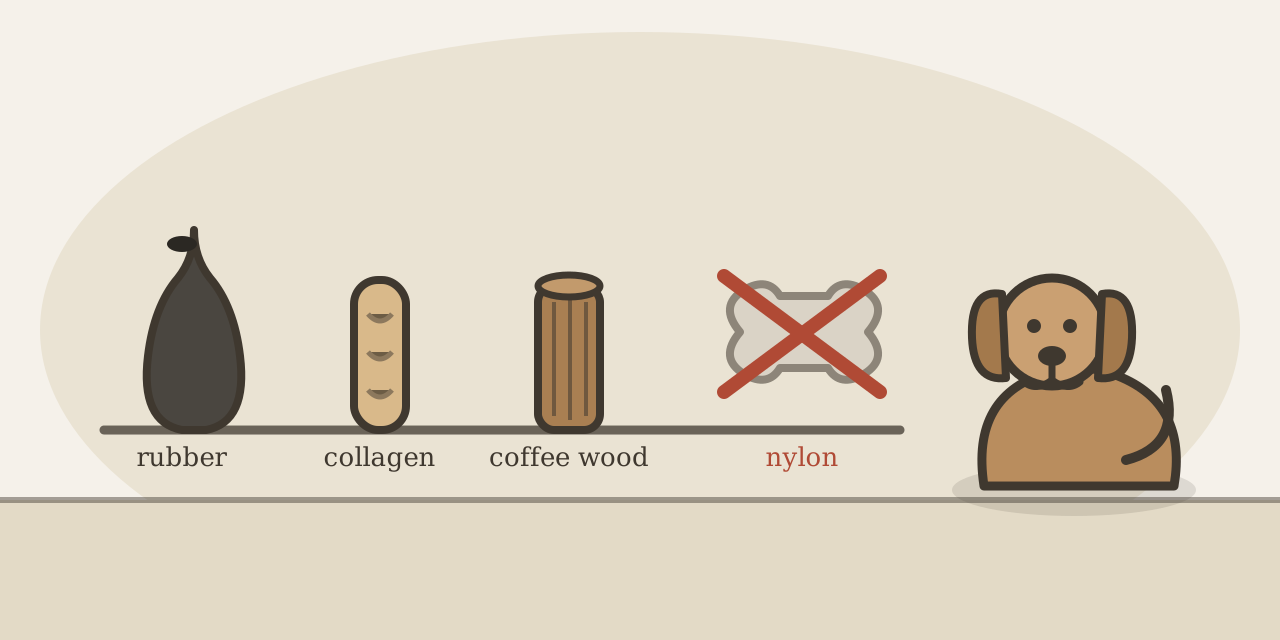
By material, in the order we'd reach for them: firm natural rubber first (fails by shredding, slowly, in view), collagen and single-ingredient natural chews for dogs that need something edible (fails by being gulped at the end, and by quietly costing a lot of calories), coffee wood for a light-to-moderate chewer that wants texture (fails into soft fibres, but won't survive a power chewer).
The tiers we don't recommend fail badly: nylon and hard plastic shed sharp fragments, antler, hoof and bone are harder than enamel, and plush is a fabric-ingestion problem the moment the seam goes.
Our Fit Analysis pick for most dogs is still the KONG Extreme — but the reason is the material, not the marketing.
Why “toughness” is the wrong axis
Shop by durability and you are ranking chews on a single number: how many minutes it survives. That number tells you nothing about the two outcomes that actually cost money and hurt dogs — a fractured tooth and an intestinal obstruction.
Worse, durability and safety pull in opposite directions past a certain point. The hardest chews on the shelf are the ones that win the durability contest and the ones veterinary dentists see most often behind a slab fracture. If you optimize for survival time alone, you walk straight into the failure mode.
Material is the better axis because material is what determines failure. Rubber and nylon can look identical on a shelf and behave nothing alike in a mouth. Two natural chews can sit side by side, one of which softens as it's worked and one of which is essentially a rock.
So this guide is organized the way the risks are organized. For each material: what it is, how long it realistically lasts, and — the part nobody prints on the packet — how it fails.
If you want the durability-first version of this question, we have it: best dog toys for aggressive chewers ranks the same category by how well it survives a power chewer. The two articles are deliberately different cuts through the same aisle, and they don't overlap on picks.
Firm natural rubber — the default, and its real failure mode
What it is: solid or hollow natural rubber, formulated firm. The category leaders are KONG's black Extreme compound, Goughnuts' rings and sticks, and West Paw's Zogoflex.
Why it's first: it sits in the narrow band between “survives the jaws” and “softer than enamel.” Run the standard screen veterinary dentists use — press a thumbnail into it; a slight dent that springs back is in the tooth-safe zone, no mark at all is too hard — and firm rubber passes while nearly every hard chew fails.
How it fails, honestly: it shreds. A determined dog works an edge, and over weeks the toy loses material in small pieces. That is a manageable failure because it is visible and gradual — you can see the toy degrading and retire it before pieces get big enough to matter. It is not a non-failure. “Indestructible” is a marketing word; no rubber toy is.
Two things make rubber punch above its weight:
- Goughnuts builds the retirement signal into the product. Their rings carry a differently-coloured inner core, so when your dog chews deep enough to expose it, the toy is telling you it's done. That solves the hardest problem in this whole category, which is knowing when to throw something away.
- Hollow rubber changes the job. Stuff a KONG or a Toppl with food and freeze it, and you have converted a durability contest into a puzzle. A frozen stuffed toy occupies a dog for far longer than the same toy empty, because the dog is now working for something rather than simply grinding. If you are already doing this with a plain KONG, a second one on rotation — one in the freezer, one in use — is the cheapest upgrade available.
Sizing rule: buy the size up from the one that looks right. A toy small enough to sit fully inside the back of the mouth is a choking risk regardless of what it's made of.
Collagen and single-ingredient natural chews — edible, but not free
What it is: beef collagen sticks, bully sticks, tendons, tracheas, and similar single-ingredient dried animal products. Collagen sticks are made from beef corium — the inner hide layer — and are the current mainstream rawhide replacement.
Why they earn a place: they are digestible, which is the one thing rubber, nylon and wood are not. When a piece is swallowed, it breaks down. That single property removes the obstruction risk that dominates every synthetic tier, and it is why we'd rather see a hard-chewing dog on collagen than on nylon.
How they fail — three ways, and the last one surprises people:
- The end nub gets gulped. As the chew shortens, the dog eventually tries to swallow the last inch or two whole. That short, dense piece is the genuine choking and blockage risk in this tier, and it is entirely preventable: take the chew away once it's short enough to fit past the back teeth, or hold the end.
- Bacterial load. Researchers at Tufts University's Cummings School tested 26 bully sticks and found nearly a third contaminated with bacteria — *E. coli* in seven sticks, MRSA in one, and *Clostridium difficile* in one. This is a handling issue rather than a reason to avoid the category: wash your hands afterwards the way you would after handling raw meat, and keep them away from anyone very young, elderly, pregnant or immunocompromised.
- The calories nobody counts. The same Tufts work found bully sticks running 9 to 22 calories per inch, averaging 88 calories in a standard 6-inch stick. That is roughly 9% of a 50-pound dog's daily requirement, and about 30% for a 10-pound dog. A daily chew habit on a small dog is a meaningful chunk of its diet, and it is invisible unless you go looking. Subtract it from dinner.
One in-tier warning: hardness varies wildly. Yak and Himalayan cheese chews are in this category on paper — dried, natural, single-ingredient — but the curing process drives out all the moisture and leaves something genuinely hard. Tooth fractures from them are a real and reported outcome, particularly in strong chewers. If you use them, the common practice is to microwave the last stub into a puffed, brittle treat rather than letting a dog work a rock-hard nub, and to run the thumbnail test on the fresh chew before it ever reaches the dog.
Coffee wood — the newest tier, and where its limit actually is
What it is: de-barked, sanded lengths of coffee tree wood, usually from Vietnamese plantations where trees have stopped producing beans. It contains no caffeine.
Why it exists: it is the answer to owners who want the texture and novelty of a stick without the emergency-vet visit that a garden stick can produce. Coffee wood's fibres are unusually tightly bound and it is harder than the wood in most forests, so it resists the classic wood failure.
How it fails — and this is the selling point: rather than shearing into sharp splinters, it wears down into soft, fine fibres that pass as roughage. That is a genuinely different failure mode from a garden stick, and it is why this tier is worth taking seriously rather than dismissing as a novelty.
Where the honesty is required: it is a natural product with some give, and the category's own guidance is that coffee wood suits light-to-moderate chewers, not power chewers. A dog that empties a KONG in an afternoon will go through a coffee wood stick fast and expensively. It also still needs the standard retirement rule — once it's short enough to swallow, it's finished.
On olive wood, which sits next to it on the shelf: it's the same idea with a less favourable fibre structure, and it is more prone to fraying and splintering. Between the two, coffee wood is the better-behaved material.
The three tiers we don't recommend — and exactly why
These are deliberately unlinked. We are not going to route you to a purchase we'd advise against.
Nylon and hard plastic “bones.” This is the tier owners most often reach for after a rubber toy dies, and it is a step backwards. Two failures compound. The hardest formulations exceed the hardness of enamel, putting them in the same fracture bracket as bone. And as a dog works one, sharp fragments shear off — VCA and other veterinary sources warn specifically about intestinal blockage from swallowed nylon pieces, and a sharp fragment carries an additional perforation risk, which is peritonitis rather than an inconvenience. Nylon is also not digestible, so nothing that goes down breaks down. If your own instinct has already ruled this tier out over tooth damage and flaking plastic, that instinct is well supported.
Antler, hoof, and real bone. Harder than teeth, straightforwardly. These are the chews most reliably associated with slab fractures of the big chewing teeth. A fractured carnassial means extraction or a root canal under general anesthesia, which costs many multiples of any chew. We go into this in more detail in is dog teeth cleaning worth it.
Plush and fabric. Fine as a comfort object for a gentle dog; not a chew. The failure mode is the seam, and once fabric and stuffing are being swallowed you have a linear-foreign-body problem, which is among the more serious obstruction presentations. A dog that has already demonstrated it swallows fabric has told you this tier is closed.
The useful pattern across all three: the tiers we skip fail suddenly and invisibly — a tooth cracks in one bite, a fragment goes down without you seeing it. The tiers we recommend fail slowly and in plain sight.
Chew materials, by how they fail
| Material | Digestible? | Tooth-safe? | How it fails | Verdict |
|---|---|---|---|---|
| Firm natural rubber | No | Yes — dents under a thumbnail | Shreds gradually and visibly | First choice for most dogs |
| Collagen / bully / tendon | Yes | Yes | Short end gets gulped; hidden calories; bacterial load | Best edible option — manage the last inch |
| Yak / Himalayan cheese | Yes | Often no — very hard once cured | Fractures teeth in strong chewers | Only with the thumbnail test and supervision |
| Coffee wood | Fibres pass as roughage | Yes | Wears into soft fibres, not splinters | Good for light-to-moderate chewers |
| Olive wood | Partly | Yes | Frays and can splinter | Coffee wood does this better |
| Nylon / hard plastic | No | No | Sheds sharp fragments; blockage and perforation risk | Skip |
| Antler, hoof, bone | No / partly | No — harder than enamel | Fractures teeth, often in one bite | Skip |
| Plush / fabric | No | Yes | Seam opens; fabric and stuffing ingested | Comfort toy only, never a chew |
If the chewing happens at night, the chew is only half the answer
A specific pattern worth naming, because it comes up constantly with adolescent dogs around seven to ten months: the dog is fine all day, and then destroys furniture legs and bed frames in the evening.
That is usually not a chew-strength problem. It's a settling problem wearing a chewing costume. An overtired adolescent that cannot switch off will find something to do with its mouth, and a harder chew simply gives it a harder thing to fail to settle around.
What tends to move it:
- Put the chew before the crash, not after it. A frozen stuffed rubber toy handed over at the start of the evening wind-down works with the dog's state. The same toy produced after it has already started on the bed frame is a reward with excellent timing for the wrong behaviour.
- Freezing is the multiplier. Frozen wet food, soaked kibble or plain yogurt in a hollow toy turns ten minutes of chewing into a much longer, calmer licking session. Licking is self-soothing in a way that grinding is not.
- Rotate two toys, not one. Novelty does a surprising amount of the work, and it costs nothing once you own two.
- Protect the furniture in the meantime. Management is not cheating. An ex-pen or a closed door removes the practice opportunity while the routine is being built, and a behaviour that never gets rehearsed is much easier to drop.
If the evening pattern comes with distress rather than boredom — pacing, vocalising, not settling even when you're present — that's a different diagnosis, and we walk through it in does my dog have separation anxiety.
The chews we'd buy, by material
Scored with the WoofTested Fit Analysis — our research rubric across chew strength, size and household setup. These are spec comparisons and user-report synthesis, not bench tests; we haven't destruction-tested these ourselves. Sizes given are for a medium-to-large dog; size up rather than down.
Rubber — best overallKONG Extreme (Large)
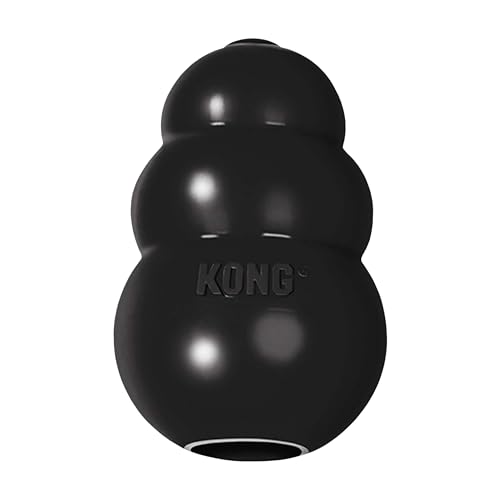
The black Extreme compound is KONG's firmest. Hollow, so it takes a frozen stuffing and becomes a puzzle rather than a grinding contest. Dishwasher safe, and cheap enough to own two and rotate.
Check price on Amazon Rubber — knows when it's done
Goughnuts Original Ring
Solid natural rubber with a differently-coloured inner core: chew through to the indicator and the toy has told you to retire it. The only mainstream chew that solves the “is this still safe?” question for you.
Check price on Amazon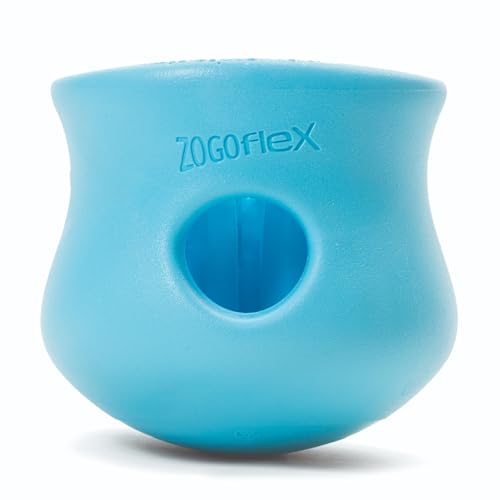 Rubber — best for freezing
West Paw Zogoflex Toppl (Large)
Bowl-shaped with interior prongs that hold food in place, so a frozen fill lasts. Freezable, dishwasher safe, and the small and large sizes lock together to make a harder puzzle as your dog gets better at it.
Check price on Amazon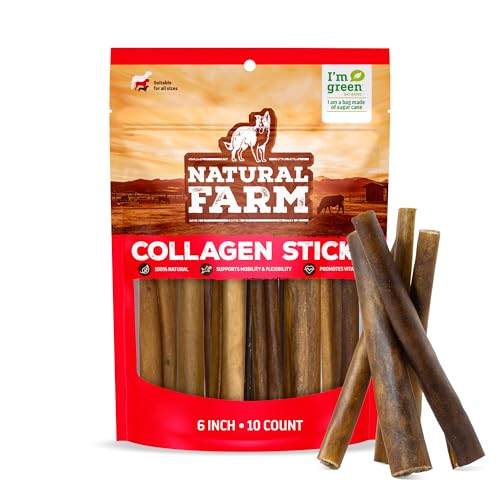 Edible — rawhide alternative
Natural Farm Collagen Sticks, 6 inch
Beef collagen, single ingredient, digestible. The tier to use when a dog needs something it can actually consume. Budget roughly 9–22 calories per inch against the day's food, and take the last stub away.
Check price on Amazon Wood-alternative
Canophera Coffee Wood Chew (Large)
Caffeine-free coffee tree wood that wears into soft fibres instead of splintering. Genuinely good for a light-to-moderate chewer that likes texture; a power chewer will go through it quickly.
Check price on Amazon Rubber — hardest in the line
Goughnuts MAXX
The step up for a dog that shreds a standard ring. Same safety-core principle, denser compound. Worth it only if you've already retired a lighter rubber toy on damage rather than boredom.
Check price on AmazonOne rule outranks every material on this page: retire a chew the moment your dog can bite a piece off it, or when what's left could be swallowed whole. Almost every chew injury we found in the veterinary literature happened at the end of a chew's life, not the beginning.
Chew materials: FAQ
What are the safest dog chews that aren't nylon or plush?
Firm natural rubber first — KONG Extreme, Goughnuts, West Paw Zogoflex — because it flexes rather than fracturing teeth and degrades visibly instead of shearing into chunks. Then digestible single-ingredient chews like beef collagen sticks, managed so the last inch doesn't get gulped. Coffee wood is a reasonable third option for a light-to-moderate chewer.
Are nylon chews actually dangerous, or is that overblown?
The concern is well founded on two fronts. The hardest nylon exceeds enamel hardness, which puts it in the tooth-fracture bracket alongside antlers and bone. And dogs shave off sharp fragments as they chew; veterinary sources warn about intestinal blockage from swallowed nylon, with sharp pieces also carrying perforation risk. Nylon is not digestible, so nothing that gets swallowed breaks down on its own.
How many calories are in a bully stick?
Tufts researchers measured 9 to 22 calories per inch across 26 sticks, averaging 88 calories for a standard 6-inch stick. That's about 9% of the daily requirement for a 50-pound dog and roughly 30% for a 10-pound dog. If your dog gets one daily, take it out of the food bowl rather than adding it on top.
Are yak cheese chews safe?
They're digestible, but the curing process removes the moisture and leaves them very hard, and tooth fractures are a documented outcome — particularly with strong chewers. If you use them, run the thumbnail test first, supervise, and don't let your dog work a short rock-hard nub. Microwaving the last piece into a puffed treat is the common workaround.
Do coffee wood chews splinter?
Much less than ordinary wood. Coffee tree wood has an unusually tight fibre bond, so it tends to wear down into soft fine fibres that pass as roughage rather than shearing into sharp splinters. Olive wood, its main shelf competitor, frays and splinters more readily. Neither survives a serious power chewer for long.
How do I know when to throw a chew away?
Two triggers. First, when a piece can be bitten off — check for missing chunks, not just wear. Second, when what remains would fit past the back teeth and could be swallowed whole. Goughnuts toys build this in with a coloured safety core; for everything else, it's a weekly look-over.
Related reading
- Best dog toys for aggressive chewers — the same aisle ranked by durability instead of material, for dogs that destroy things fast.
- Is dog teeth cleaning worth it? — what a fractured tooth actually costs, and the dental care that prevents it.
- Does my dog have separation anxiety? — when destructive chewing is distress rather than boredom.
- Best slow feeder dog bowls — the other half of the mouth-occupation problem.